Quick Share is the Android feature most people meet by accident, usually as a pop-up from a phone they do not know. It has one job, it is already on your phone, and one setting decides everything about it. Here is what it does, who can see you, and what to set it to.
The quick answer: Quick Share is Android's built-in way to send a photo, video or file straight to a device beside you, with no cable, no app to install and nothing uploaded to a company's server. Google called it Nearby Share until 2024. Set its visibility to Your own devices and it is safe to leave switched on. To land a phone photo on a computer clipboard rather than in a folder, one small app does that. Free for iPhone Free for Mac Free for Android Free for Windows

Quick Share sends a file straight to a phone next to you
Start with the one-sentence version, because the name gives nothing away.
- Quick Share is Android's built-in feature for sending a file to a device standing beside you. You pick a photo, tap share, and choose the other device from a short list of names.
- Quick Share moves the file directly between the two devices, so it passes through nobody's server. The photo leaves your phone and arrives on theirs. Nothing is uploaded and nothing is stored anywhere in between.
- Quick Share needs no account, no phone number and no app on either side. Both devices already carry it, so neither person signs up for anything first.
- Quick Share does the same job on Android that AirDrop does on an iPhone. Apple shipped AirDrop first and Google answered with this.
- Quick Share works with no mobile data and no Wi-Fi network to join. The two devices build a direct link of their own, so a train with no signal changes nothing.

Google and Samsung merged Nearby Share into Quick Share in 2024
Most "I cannot find this setting" moments come down to the name, so a short history helps.
- Samsung used the Quick Share name for four years before Google adopted it in 2024. That is why a search for Quick Share still returns mostly Galaxy phones.
- Google's Nearby Share and Samsung's Quick Share were rival features that merged into one in 2024. The merged feature kept the Quick Share name, so Pixel owners saw a rename rather than a replacement.
- An Android phone that has not updated since 2024 still calls the feature Nearby Share. Nothing is broken on that phone. Look for either name in Settings.
- Guides written before 2024 treat Nearby Share and Quick Share as two competing features. They were right at the time, and some still rank well, which is why their steps contradict each other.
- Quick Share is on every modern Android phone, not only on a Samsung. Pixel, Xiaomi, OPPO, Sony and the rest all carry it now.
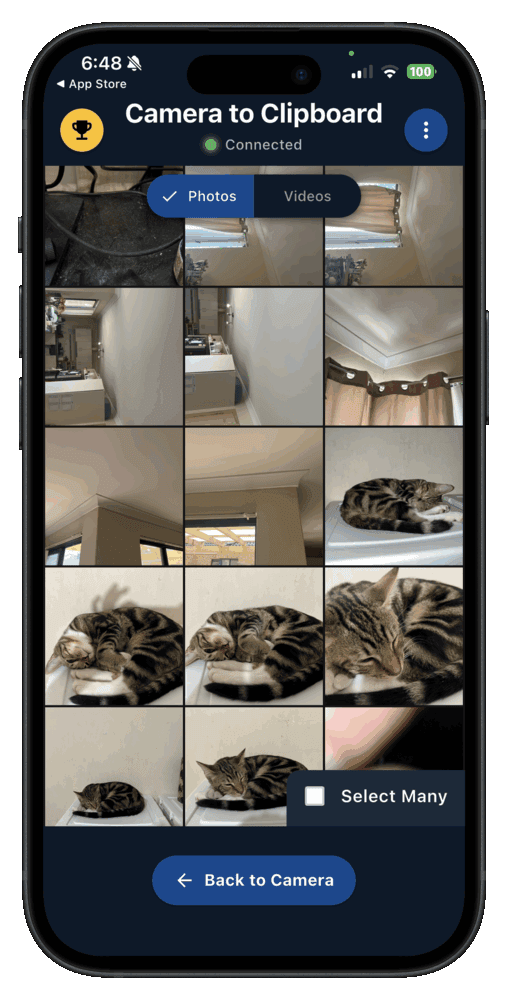
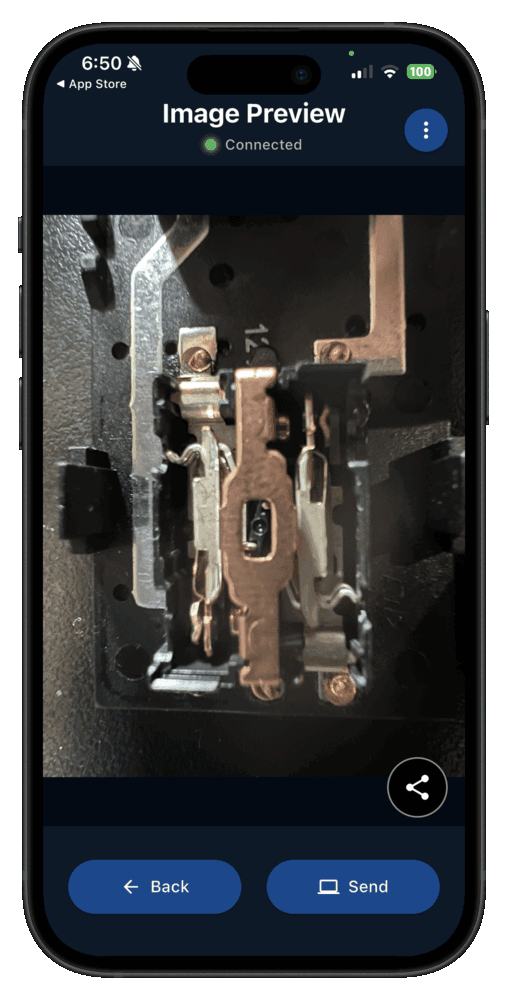
Camera to Clipboard puts an Android photo on your computer clipboard
Quick Share is built for phone to phone. Getting a photo onto the computer you are working at is a different job, and a different tool does it better.
- A photo sent with Camera to Clipboard lands on the Windows or Mac clipboard, ready for Ctrl + V. There is no folder to open afterwards and no file to attach.
- Camera to Clipboard runs on any Android phone and on iPhone, so it does not care which brand you own. Quick Share reaches Android and Windows only.
- Camera to Clipboard sends the photo from the phone to the computer across your own network. Nothing is uploaded to a cloud service. The two apps use the internet only to find each other, so a phone hotspot works as well.
- Camera to Clipboard sends one photo or a whole batch straight from the phone's gallery. Scanned documents and video clips cross the same way.

Pair Camera to Clipboard with your computer in four steps
Pairing happens once, and it takes about ten seconds.
- Install Camera to Clipboard on the phone and the desktop app on the computer.
- Pair them once by scanning a QR code.
- Take or pick a photo on the phone and send it.
- Press Ctrl + V on the computer, or Cmd + V on a Mac.
A video clip travels the same way. It is saved as a file on the computer, never re-encoded, and its file path goes on the clipboard.
Free to download and try on both ends. The free version adds a small watermark and caps photos at 1920px. Pro removes both.

Send a file with Quick Share in four steps
Using it is shorter than reading about it, and it looks the same on every Android phone.
- Open the photo, video or file on the sending phone and tap Share.
- Tap Quick Share in the share sheet.
- Pick the other device when its name appears in the list.
- Accept the file on the receiving device.
Both devices need Bluetooth and Wi-Fi switched on, and they need to be within about a metre of each other while they find one another. The receiving device must also be visible to you, which is the setting covered further down.

Quick Share carries photos, videos, folders and links of any size
What you can put through it is wider than most people assume.
- Quick Share sends photos and videos at their original size, with no second round of compression. A chat app shrinks a photo on the way. Quick Share does not touch it.
- Quick Share sends any file type, including PDFs, ZIP archives, app files and whole folders. It is a general file transfer, not a photo feature.
- Quick Share sets no size limit of its own, so a long video crosses as readily as a single photo. How long it takes depends on the two devices, not on a cap.
- Quick Share can also send a link or a piece of text rather than a file. Whatever the share sheet offers can go through it.
- Samsung phones add a Quick Share link option that uploads the file to Samsung's server instead of sending it directly. That link expires after a few days. Picking the device from the list keeps the transfer direct.

Quick Share is already on your phone, so there is nothing to install
People go hunting in the Play Store for it. It is not there, and it never was.
- Quick Share ships as part of Android itself, so there is no Quick Share app to download. Searching the Play Store for the name finds copycat apps, not the feature.
- Quick Share sits in the Quick Settings panel you pull down from the top of the screen. Swipe down twice and look for the tile, which may need adding from the edit screen.
- Quick Share also has a settings page, usually under Connected devices or under Google. Every phone maker files it somewhere slightly different.
- Quick Share cannot be uninstalled, because it is part of the operating system. Switching it off is as far as anyone can take it.

The visibility setting decides who can see your phone in Quick Share
One setting does nearly all the work in Quick Share, and it has four levels.
- Quick Share's Everyone nearby level lets any Android phone in Bluetooth range see your phone's name. It is the only level on which a stranger can reach you at all.
- Quick Share's Your contacts level shows your phone only to people saved in your contacts. They have to be signed in as well, or your phone stays hidden from them too.
- Quick Share's Your own devices level shows your phone only to devices signed into your own Google account. Your tablet and laptop still find it. Nobody else does.
- Quick Share's Nobody level hides your phone and stops you sending out as well. That level is the same thing as switching Quick Share off.
- Quick Share's Everyone nearby level is built to be temporary, and most phones drop out of it after about ten minutes. It suits one handover with someone new, not a permanent state.
- You can change the name your phone shows other people on the Quick Share settings screen. Pick something anonymous if you would rather strangers did not read your real name.

Quick Share is safe to leave on unless you set it to Everyone
The worry behind most searches for this feature is whether a stranger can push something onto your phone. The honest answer has two halves.
- A stranger can only see your phone in Quick Share while visibility is set to Everyone nearby. On any other level your phone is simply invisible to them.
- Quick Share always asks you to accept a file before it arrives, so nothing lands on your phone silently. A prompt names the sender and the file first.
- Quick Share encrypts the transfer between the two devices. Somebody else on the same Wi-Fi cannot read what crosses.
- The real nuisance of Everyone nearby is unwanted pop-ups in a crowded place, not a silent download. Trains, airports and lecture halls are where people meet it.
- Accepting a file from a stranger is the actual risk in Quick Share, and that part is your decision. Treat an unexpected file the way you would treat an unexpected email attachment.
- Setting Quick Share to your own devices removes the pop-ups and keeps the feature working. You give up nothing except strangers being able to find you.

Quick Share can turn itself back on after a system update
A feature reappearing after you switched it off is a common complaint, and it is usually one of three things.
- A major Android or One UI update can restore Quick Share's default visibility, so a phone you had hidden becomes visible again. Check the tile after any large update.
- Quick Share's Everyone nearby level expires on purpose and falls back to a safer level by itself. That looks like the setting changing on its own, and it is meant to.
- The Quick Share tile sits in the Quick Settings panel next to tiles people press often, so it gets switched on by accident. One stray tap is enough.
- Quick Share cannot be removed from the phone, so it will always be there to switch back on. There is no uninstall to reach for.

Quick Share reaches Android and Windows but not a Mac
What sits on the other end decides whether Quick Share is any use to you at all.
| Device on the other end | Does Quick Share reach it | What you need first | What to use instead |
|---|---|---|---|
| Another Android phone | Yes, on every modern phone | Nothing, it is built in | Nothing, this is what it is for |
| A Chromebook | Yes, built into ChromeOS | Nothing, it is built in | Nothing, this is what it is for |
| A Windows PC | Yes, with a free app from Google | Install Quick Share for Windows | Camera to Clipboard for a photo you want to paste |
| An iPhone | Only from a few recent phones | A supported Galaxy or Pixel | A cloud link or a chat app, see the iPhone guide |
| A Mac | No, and Google ships no Mac app | Nothing makes it work | Camera to Clipboard for a photo you want to paste |
Two of those rows catch people out, so they are worth stating plainly.
- Quick Share reaches a Windows PC only after you install Google's free Quick Share app for Windows. A PC with nothing installed never appears in the list.
- Quick Share never reaches a Mac, because Google has published no Mac version of the app. No setting on either machine changes that.
- Quick Share reaches an iPhone only from a handful of recent Galaxy and Pixel models. Google bridged Quick Share to AirDrop in 2025, and only the newest phones carry the bridge. The Android to iPhone guide lists what works.

Quick Share and AirDrop do the same job on rival phones
Most people arrive here having used the Apple one, so the comparison is the fastest explanation available.
- AirDrop is Apple's version of this feature and Quick Share is Android's, and neither is built on the other's code. Two companies solved one problem twice.
- AirDrop and Quick Share both send at full quality straight between two devices. Neither one shrinks a photo the way a messaging app does.
- Apple has never opened AirDrop to other companies, so Google had to build the bridge from the Android side. That is why the bridge exists only on new Android phones and not on old ones.
- AirDrop's Everyone setting and Quick Share's Everyone nearby setting carry the same risk of unwanted pop-ups. Apple now expires its Everyone setting after ten minutes for exactly that reason.

Leave Quick Share on and set it to your own devices
If you take one action away from this page, take this one.
- Set Quick Share to Your own devices and you keep the feature with none of the pop-ups. This is the setting most people were looking for when they went hunting for the off switch.
- Switch Quick Share to Everyone nearby only for the minute you are receiving something from a new person. Most phones switch it back for you afterwards.
- Turn Quick Share fully off only if you never move files between your own phone, tablet and laptop. Off means switching it on again every single time you want to send something. The full turn-off guide covers every switch.
Common questions about Quick Share
What is Quick Share?
Quick Share is Android's built-in feature for sending a photo, video or file straight to a device next to you. The file goes directly between the two devices over a link they build themselves, so nothing is uploaded and nothing passes through a company's server. It needs no account and no app, because every modern Android phone already has it. Google called it Nearby Share until 2024.
Is Quick Share safe to leave switched on?
Yes, on every visibility level except Everyone nearby. That is the only level on which a stranger can see your phone, and even then Quick Share asks you to accept a file before it arrives, and it encrypts the transfer. Set the visibility to Your own devices and no stranger can find your phone at all.
Do I need Quick Share, or can I turn it off?
You can turn it off, and nothing else on the phone breaks. It is worth keeping if you ever move a file between your own phone, tablet or laptop, because turning it off means turning it back on every time. Setting it to Your own devices is the middle ground most people want.
Why is it called Nearby Share on my phone?
Nearby Share was Google's name for the feature until 2024, when it merged with Samsung's Quick Share and kept the Quick Share name. A phone that has not had a major update since then still shows the old name. The feature is the same one.
Can Quick Share send to an iPhone or a Mac?
A Mac, no. Google has published no Mac version. An iPhone, only from a handful of recent Galaxy and Pixel phones that carry Google's 2025 bridge to AirDrop. To get a phone photo onto a Mac or a PC, Camera to Clipboard puts it straight on the clipboard from any phone.