
Most people looking for this have a reason. A stranger on a train has pushed something unwanted onto their screen. A child's iPad keeps receiving files from classmates. Or a phone is announcing itself to every device in the room. AirDrop switches off in about five seconds, and it can also be locked off for good. Here is every way to do it.
The quick answer: open Control Centre, press and hold the connectivity card, tap AirDrop and choose Receiving Off. That is the real off switch. The same choice sits in Settings > General > AirDrop. On a Mac, open Finder, click AirDrop in the sidebar and pick No One. Screen Time stops a child turning it back on. Free for iPhone Free for Mac Free for Android Free for Windows

Turn AirDrop off in Control Centre with four taps on an iPhone
This is the one to reach for when something unwanted has just arrived.
- Swipe down from the top-right corner of the screen. On an iPhone with a Home button, swipe up from the bottom edge instead.
- Press and hold the card in the top left, the one holding Aeroplane Mode, Wi-Fi and Bluetooth.
- Tap the AirDrop icon that appears once the card expands.
- Choose Receiving Off.

Receiving Off is the only AirDrop setting that refuses every file
Five details decide whether that sequence does what you expect.
- Receiving Off is the only one of AirDrop's three settings that genuinely turns AirDrop off. Contacts Only and Everyone both leave the phone listening for incoming files.
- The AirDrop control hides inside the Control Centre connectivity card rather than sitting on the main grid. A normal tap on that card does nothing useful. You have to press and hold to expand it.
- Choosing Receiving Off takes effect straight away and stays set until you change it. It is a setting, not a temporary mute, so it survives locking the phone and restarting it.
- An iPad turns AirDrop off through the same expanded Control Centre card as an iPhone. Swipe down from the top-right corner, press and hold the same group of icons, and pick Receiving Off.
- An iPhone set to Receiving Off can still send an AirDrop to somebody else. The setting only governs what is allowed to arrive. Starting a share yourself opens the connection for that one transfer.

Camera to Clipboard sends a phone photo with AirDrop switched off
Switching AirDrop off stops the pestering, and it does nothing about getting a photo off your phone. That job needs a different tool.
- Camera to Clipboard sends a phone photo to a computer over your own Wi-Fi and does not use AirDrop at all. Leaving AirDrop on Receiving Off changes nothing about whether it works.
- A photo sent with Camera to Clipboard lands on the computer's clipboard rather than in a downloads folder. Press Ctrl + V or Cmd + V in whatever you are working in.
- Camera to Clipboard works from an iPhone or an Android phone to a Windows PC or a Mac, which AirDrop has never done. AirDrop is Apple to Apple only. That is why AirDrop for Windows and AirDrop for Android are searches.
- Camera to Clipboard sends the photo straight between the two devices, with nothing uploaded to a cloud service. The two apps use the internet only to find each other. A phone hotspot works too, because its mobile data connects both apps.
- Camera to Clipboard sends one photo or a whole batch in a single go. Videos and scanned documents travel the same way.
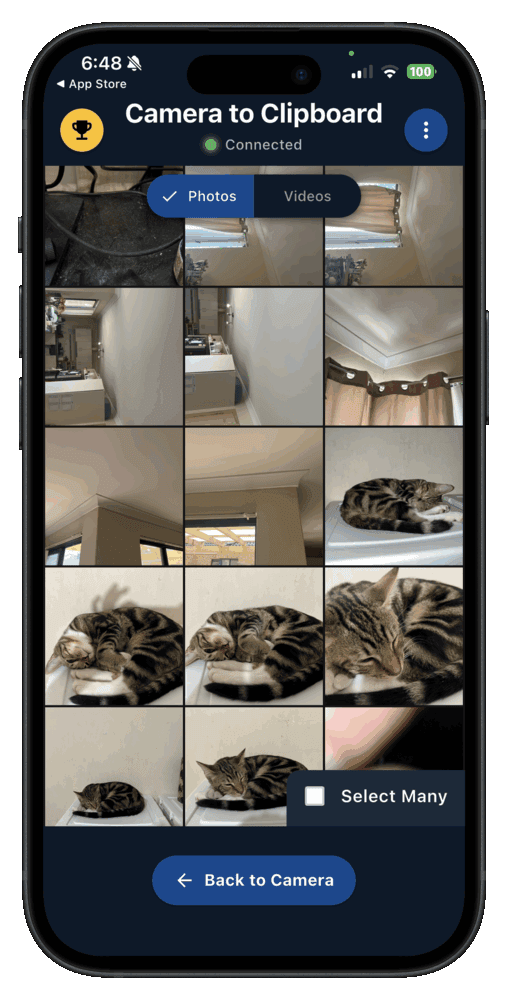
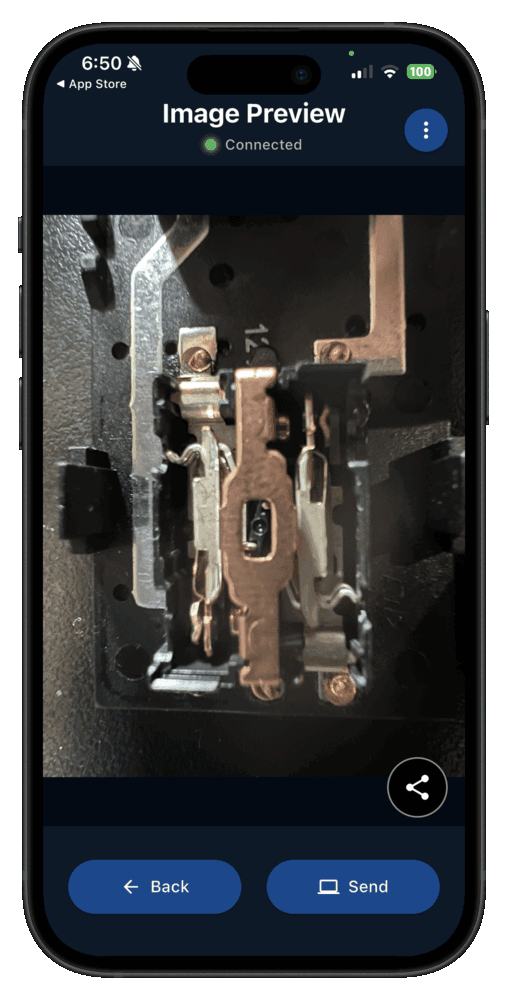
Pair Camera to Clipboard once and paste the photo on the computer
Pairing happens once, and it takes about ten seconds.
- Install Camera to Clipboard on the phone and the desktop app on the computer.
- Pair once by scanning a QR code.
- Take or pick a photo on the phone and send it.
- Press Ctrl + V or Cmd + V on the computer.
Free to download and try on both ends. The free version adds a small watermark and caps photos at 1920px. Pro removes both.

Open Settings > General > AirDrop to see all three choices named
Control Centre is quicker. The Settings screen is the one to open when you want to see what you are picking between.
- Settings > General > AirDrop is the same screen on an iPhone and an iPad, and it ticks the active choice. Reading a tick is more reliable than reading a Control Centre icon, which only shows you a symbol.
- Choosing Receiving Off in Settings and choosing it in Control Centre change the same single setting. There is no separate Settings-only switch, so use whichever you have open.
- A Mac has no Settings > General > AirDrop screen, and its equivalent is System Settings > General > AirDrop & Handoff. The Mac steps are further down this page.
- Turning AirDrop off in Settings does not sign you out of iCloud or alter any other sharing feature. Nothing else on the phone moves, and no app loses access to anything.

Contacts Only blocks strangers and Receiving Off blocks everyone
Picking between the three settings is easier once you know what each one lets through.
- Receiving Off refuses every incoming AirDrop, including files from your own family and your own other devices. Nothing reaches the phone and nothing prompts you. That is right in public and mildly annoying at home.
- Contacts Only accepts an AirDrop only from somebody already saved in your contacts. A person on a train cannot be in your contacts, so they cannot reach you, and your friends still can.
- Contacts Only needs you signed in to iCloud, and needs the sender's Apple ID email or phone number saved in their contact card. A friend who is genuinely in your contacts can otherwise fail to appear. That is a missing detail on the card rather than a fault.
| AirDrop setting | Who can send you a file | How long the setting lasts | Unwanted photos from strangers | What it stops you receiving |
|---|---|---|---|---|
| Receiving Off | Nobody, every request is refused | Until you change it back | None possible | Everything, family included |
| Contacts Only | People saved in your contacts | Until you change it back | None, a stranger is not a contact | Files from anyone unsaved |
| Everyone for 10 Minutes | Anyone nearby, strangers included | 10 minutes, then Contacts Only | This setting is what allows them | Nothing at all |

Everyone for 10 Minutes is what lets a stranger reach your iPhone
One of the three settings is the reason unwanted photos arrive at all.
- Everyone for 10 Minutes is the only AirDrop setting that lets an unknown person nearby send you a file. If you have been receiving unwanted photos, this is the setting your phone was on.
- An unwanted AirDrop does its damage through the preview thumbnail in the prompt. You see the image before you have accepted anything, so declining does not help. AirDrop has no accounts, so there is no sender to block.
- Sending an unsolicited explicit image, including by AirDrop, is a criminal offence in England and Wales under the Online Safety Act 2023. Several other countries and US states have passed comparable laws. Reporting it to transport staff or the police is a real option.

Apple replaced the permanent Everyone option with a 10-minute timer
Older advice assumes a phone can sit on Everyone forever, and that is no longer true.
- Apple removed the permanent Everyone option from AirDrop and replaced it with Everyone for 10 Minutes. The change shipped in iOS 16.2 at the end of 2022. It had reached iPhones sold in mainland China a few weeks earlier.
- Apple's stated reason for putting a timer on AirDrop's Everyone setting was to cut down unwanted file sharing. The permanent version was what made unsolicited sending easy. Most phones left on it had been forgotten about years earlier.
- An iPhone left on Everyone for 10 Minutes returns to Contacts Only by itself. There is no notification and no action from you, so a phone can no longer sit open to strangers for months.

Choose Everyone for 10 Minutes to accept one file from a colleague
The timer is what makes the loosest setting safe to pick on purpose.
- Choosing Everyone for 10 Minutes deliberately is the sensible way to accept one file from somebody not in your contacts. Take the file, then let the timer put the phone back to Contacts Only.
- The 10-minute AirDrop timer restarts from scratch every time you choose Everyone for 10 Minutes again. It is not a daily allowance, and there is no limit on how often you can pick it.

Set AirDrop to No One in the Finder sidebar on a Mac
A Mac has the same three levels as an iPhone, and it names the strictest one differently. That is the main reason people cannot find it.
- No One is the Mac's name for the setting an iPhone calls Receiving Off. Looking for the words "Receiving Off" on a Mac is a dead end, and that naming difference is the whole confusion.
- The Mac AirDrop setting sits at the bottom of the Finder AirDrop window, beside "Allow me to be discovered by". Open Finder, click AirDrop in the sidebar, and set that menu to No One.
- A Mac set to No One can still send an AirDrop, exactly as an iPhone set to Receiving Off can. Switching it off does not stop you sharing a file to somebody who has theirs on.

Switch Mac AirDrop off from the menu bar or from System Settings
Finder is not the only door to that setting, and all of them lead to one place.
- Control Centre in the Mac menu bar switches AirDrop off without opening Finder at all. Click the Control Centre icon, then click the AirDrop button to switch it off. Click its label instead to pick between No One, Contacts Only and Everyone.
- System Settings > General > AirDrop & Handoff holds the same Mac AirDrop choice as Finder and Control Centre do. Three doors, one setting behind them, so it does not matter which you use.

Lock AirDrop off with Screen Time so a child cannot turn it back on
Switching AirDrop off in Control Centre lasts until a child switches it on again. This version holds, and it is the answer for a school iPad.
- On the child's device, open Settings > Screen Time.
- Tap Content & Privacy Restrictions and turn restrictions on.
- Tap Allowed Apps, which newer iOS versions call Allowed Apps & Features.
- Switch AirDrop off.

Screen Time removes AirDrop from Control Centre and the Settings app
Four things follow from doing it this way rather than from Control Centre.
- Turning AirDrop off through Screen Time removes it from Control Centre and from the Settings app entirely. There is no greyed-out switch left over, so the feature is not just off but gone.
- A Screen Time passcode has to be different from the device unlock code, or the AirDrop restriction is worthless. A child who watched you unlock the phone can otherwise undo the whole thing in fifteen seconds.
- Screen Time restrictions on a child's iPhone or iPad can be set from a parent's phone through Family Sharing. You do not need the device in your hand, which matters once it leaves the house.
- Switching AirDrop off in Screen Time blocks sending as well as receiving. AirDrop disappears from the share sheet too, so a child cannot send photos to classmates either. That is usually the point.

Turn NameDrop off under Bringing Devices Together in AirDrop settings
Some of the people hunting for the AirDrop switch are really after this one. It lives on the same screen.
- NameDrop swaps contact cards between two iPhones held close together, and it is switched on by default. Apple added it in iOS 17. It is the feature behind every warning about phones exchanging details by touching.
- Settings > General > AirDrop > Bringing Devices Together is the switch that turns NameDrop off. It sits underneath the three receiving choices on the same screen, which is why it is easy to walk past.
- NameDrop only triggers when both iPhones are unlocked and almost touching, and either person can cancel it. A phone in a pocket or on a table cannot be made to hand over a contact card.
- NameDrop shares a contact card and never shares photos, files or anything else on the phone. It is a different feature from AirDrop file sharing despite sharing a settings screen with it.

Turning AirDrop off leaves Bluetooth and Wi-Fi switched on
People hesitate over this switch because AirDrop clearly uses the radios. It takes nothing else down with it.
- AirDrop finds nearby devices over Bluetooth and then moves the file over a direct Wi-Fi link. That link is made between the two devices themselves, so no router is involved in the transfer.
- Turning AirDrop off leaves Bluetooth switched on, so headphones, a watch and a car stereo all keep working. AirDrop is one user of Bluetooth among many, and switching it off does not touch the radio.
- Turning AirDrop off leaves Wi-Fi switched on, so nothing about your internet connection changes. Web pages, streaming and downloads are all unaffected.

Handoff, Universal Clipboard and AirPlay survive turning AirDrop off
The rest of the Continuity family carries on, and so does every other way of sending a file.
- Turning AirDrop off does not affect Handoff, Universal Clipboard or AirPlay. Those are separate features with their own switches, even though they use the same radios.
- Turning AirDrop off does not stop you sending files by iMessage, Mail or any app. The only thing that stops is AirDrop's own device-to-device sharing.

Leave an iPhone on Contacts Only and use Receiving Off in a crowd
Every setting on this page has a situation it is right for. Match it to where you are.
- Contacts Only is the AirDrop setting to leave an iPhone on from one day to the next. No stranger can reach you, your friends and your own devices still can, and nothing needs changing.
- Receiving Off is the AirDrop setting for a crowded train, a festival or a lecture theatre. It refuses everything, so nothing can appear on your screen no matter who is standing next to you.
- Everyone for 10 Minutes is worth choosing on purpose for a single file from somebody not in your contacts. The timer puts the phone back to Contacts Only without you having to remember.

Use Screen Time on a child's device and No One on a Mac
Two situations need a different answer from the everyday one.
- Screen Time is the way to turn AirDrop off on a child's iPhone or iPad so that it stays off. Control Centre lasts until the child opens Control Centre, and Screen Time removes the feature altogether.
- No One is the Mac setting that matches Receiving Off on an iPhone, and Finder is the quickest place to set it. Control Centre in the menu bar does the same job in one fewer click.
- Camera to Clipboard is the tool for moving a phone photo to a computer once AirDrop is switched off. It runs over your own Wi-Fi and reaches a Windows PC as easily as a Mac.
Common questions about turning AirDrop off
How do I turn off AirDrop on my iPhone?
Open Control Centre, press and hold the card in the top left that holds Aeroplane Mode and Wi-Fi, tap AirDrop and choose Receiving Off. The same choice sits in Settings > General > AirDrop. Receiving Off refuses every incoming AirDrop and stays off until you change it. You can still send an AirDrop to somebody else while it is set.
How do I stop strangers sending me AirDrop photos in public?
Set AirDrop to Contacts Only, or to Receiving Off if you want nothing at all. Everyone for 10 Minutes is the only setting a stranger nearby can use to reach your phone. It now expires by itself after 10 minutes and drops back to Contacts Only. A phone can no longer sit open to strangers for weeks.
Can I stop my child turning AirDrop back on?
Yes. Open Settings > Screen Time > Content & Privacy Restrictions, turn restrictions on, tap Allowed Apps, and switch AirDrop off. AirDrop then disappears from Control Centre and from the Settings app, so there is nothing left to switch back on. Set a Screen Time passcode that is different from the device unlock code, or the child can simply undo it.
Does turning off AirDrop turn off Wi-Fi or Bluetooth?
No. AirDrop finds nearby devices over Bluetooth and then moves the file over a direct Wi-Fi link. Turning AirDrop off leaves both radios running for everything else. Headphones, watches, car stereos and your internet connection are untouched, and Handoff, Universal Clipboard and AirPlay keep working.