
AirDrop fails without saying anything. The other device is simply not in the list, or the transfer sits on Waiting. There is no error to look up. AirDrop quietly depends on nine separate things being true at the same moment. Any one of them takes it out. This page walks through all nine, in the order that finds the fault fastest.
The quick answer: turn Personal Hotspot off, and switch Bluetooth and Wi-Fi on in Settings. Wake and unlock both devices. On the device you are sending to, set AirDrop Receiving to Everyone for 10 Minutes. That combination fixes most cases. AirDrop never reaches a Windows PC, so that job needs a different app. Free for iPhone Free for Mac Free for Android Free for Windows

Run six quick checks that fix most AirDrop failures
Run these six on both devices before you read anything else. Each one takes a few seconds.
- Wake and unlock both devices, and keep both screens on.
- Bring them within about 9 metres, ideally into the same room.
- Open Settings on both and switch Bluetooth and Wi-Fi on.
- Switch Personal Hotspot off on the iPhone.
- On the receiving device, set AirDrop Receiving to Everyone for 10 Minutes.
- Send again, and watch the receiving screen rather than the sending one.
If that got you moving, you are done. If it did not, every condition below has its own section.

Camera to Clipboard sends a photo with fewer parts to go wrong
Fixing AirDrop is worth doing, and the rest of this page does it. The photo is often heading into a document or an email on a computer. There is a shorter path to that.
- Camera to Clipboard sends a phone photo to a computer over your local Wi-Fi, with no Bluetooth involved. That removes a whole category of the discovery failures on this page.
- A photo sent with Camera to Clipboard lands on the computer's clipboard rather than in a folder. Press Ctrl + V on a PC or Cmd + V on a Mac. There is no file to find afterwards.
- Camera to Clipboard works between an iPhone and a Windows PC, which AirDrop has never done. The AirDrop for Windows guide covers what your options there actually are.
- Camera to Clipboard uploads the photo to no cloud service at all. The two apps use the internet only to find each other. The photo itself crosses your own Wi-Fi.
- Camera to Clipboard needs both devices on the same Wi-Fi, and enough of a connection for the two apps to find each other. AirDrop makes its own link and needs neither, so it still wins on a train with no signal.
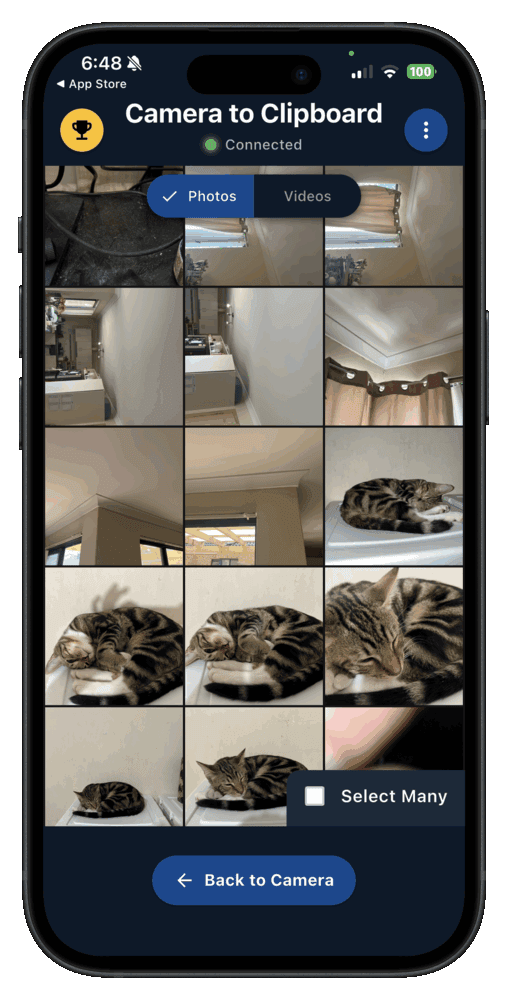
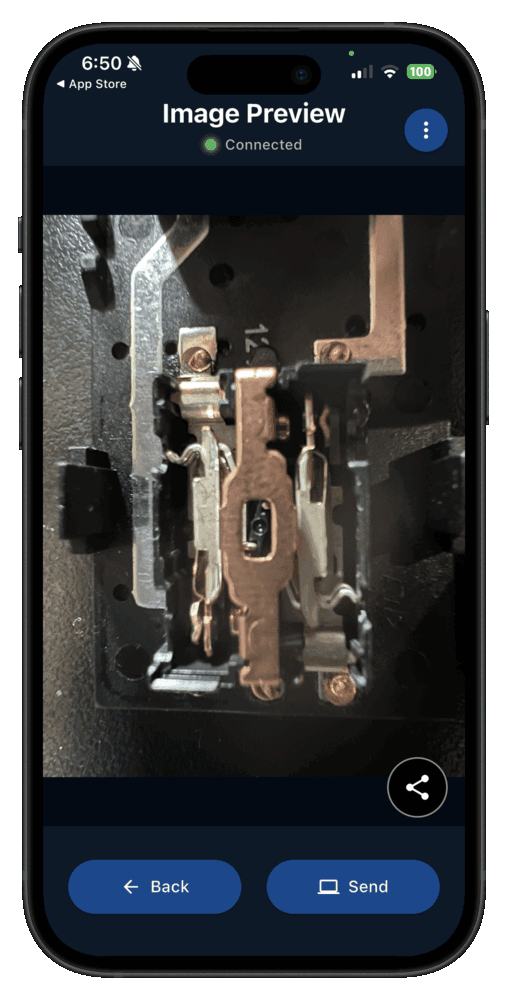
Send a photo to the computer with Camera to Clipboard in four steps
The whole thing is four steps, and you only do the first two once.
- Install Camera to Clipboard on the phone and the desktop app on the computer.
- Pair once by scanning a QR code, about ten seconds.
- Take or pick a photo on the phone and send it.
- Press Ctrl + V or Cmd + V on the computer.
Free to download and try on both ends. The free version adds a small watermark and caps photos at 1920px. Pro removes both.

Turn Personal Hotspot off first when AirDrop stops for no reason
This is the single most common cause, and almost nobody guesses it.
- Personal Hotspot switched on stops AirDrop working, and nothing on the iPhone says so. The Wi-Fi radio can only do one job at a time. Sharing a connection takes it away from the direct link AirDrop needs.
- Switching Personal Hotspot off is the first thing to try when AirDrop stopped for no obvious reason. Open Settings > Personal Hotspot, switch Allow Others to Join off, and send again.

Check Personal Hotspot on the other iPhone as well as your own
A hotspot only takes AirDrop out on the phone that is sharing it. It matters which of the two phones that is.
- Personal Hotspot on the receiving iPhone breaks AirDrop exactly as much as on the sending one. Check both phones, because people almost always check only the one they are holding.
- An iPhone can be sharing its hotspot without you switching it on today, because the setting stays on until someone turns it off. A laptop that joined it last week keeps it awake.
- An iPhone that is joined to somebody else's hotspot can still use AirDrop normally. Only the phone sharing the connection loses AirDrop, so being a guest is not the problem.

Switch Bluetooth and Wi-Fi on in Settings at both ends
AirDrop uses both radios, for two different jobs, and it needs them at both ends.
- AirDrop uses Bluetooth to find the other device and Wi-Fi to carry the file. Switching either one off breaks it. A device with Bluetooth off never appears in anyone's AirDrop list.
- Both radios have to be on at both ends, not only on the phone you are holding. Check Bluetooth and Wi-Fi in Settings on the other device too.
- Airplane Mode switches off both of the radios AirDrop depends on. Switching Wi-Fi and Bluetooth back on individually does work, with Airplane Mode still on. That is worth knowing on a flight.

AirDrop needs no Wi-Fi network and no internet connection
The Wi-Fi radio and a Wi-Fi network are two different things. AirDrop only asks for the first.
- AirDrop needs the Wi-Fi radio switched on, but no network and no internet. Once Bluetooth has found the other device, the two build a direct Wi-Fi link between themselves. That is why AirDrop works in a field with no signal.
- The two devices do not have to be on the same Wi-Fi network for AirDrop to work. This one trips people up in the other direction. They join a phone to a network that was never needed.
- Turning Wi-Fi or Bluetooth off from Control Center deliberately leaves AirDrop working, while turning them off in Settings stops it. The Control Center buttons only disconnect the current network or accessory. Apple keeps the radios alive on purpose.

Contacts Only is why the person you want never appears
An empty list of people is the most common way AirDrop fails. The receiving setting is behind nearly all of it.
- AirDrop set to Contacts Only shows you nobody unless that person is already saved in your Contacts. The device is not broken and not out of range. It is hiding from anyone it does not recognise.
- Contacts Only matches on the Apple Account email address or phone number, not on the name on the contact card. A colleague saved under their work email does not match if they sign in to iCloud with a personal one.
- Contacts Only needs both people signed into iCloud on the devices they are holding. A device signed out of iCloud has no identity to check against, so it stays invisible.

Ask the receiver to pick Everyone for 10 Minutes and send again
The receiving device decides who can see it. The setting to change is on that phone.
- Setting AirDrop Receiving to Everyone for 10 Minutes is the fastest way to prove Contacts Only is the problem. If the person appears the moment they switch it, you have your answer.
- The Everyone setting turns itself back to Contacts Only after ten minutes. Apple made it time limited on purpose, to stop unwanted files from strangers. It is why an AirDrop fix that worked yesterday does not work today.
- AirDrop Receiving set to Receiving Off makes a device invisible to everyone, including people in its Contacts. The setting is at Settings > General > AirDrop on an iPhone or iPad.

Wake the receiving device and turn Focus off before you send
Sometimes AirDrop is working and the transfer is simply waiting for somebody to say yes.
- An AirDrop prompt only appears on a device that is awake and unlocked. A phone lying face down in a bag never shows it. The sender sees nothing but Waiting.
- A Focus mode or Do Not Disturb silences the banner and sound that announce an incoming AirDrop. The prompt can sit unnoticed on a screen nobody has looked at, so switch the Focus off first.
- Watching the receiving screen while the other person sends settles in seconds whether the prompt appears. Almost everybody watches the sending device, which is the screen that cannot tell you anything useful.

AirDrop between your own devices accepts with no prompt at all
Two AirDrop outcomes leave the sender with nothing to look at. Neither one is a fault.
- AirDrop between two devices signed into the same Apple Account accepts automatically, with no prompt. A photo sent from your iPhone to your own iPad has already arrived and is in Photos.
- Tapping Decline on an AirDrop prompt ends the transfer with no message on the sending device. If somebody dismissed it by accident, the sender is left thinking AirDrop failed.

Clear the block all incoming connections setting on the Mac
If the device nothing can reach is a Mac, the Mac has two settings of its own to check.
- A Mac firewall set to block all incoming connections stops AirDrop reaching that Mac. The option is a blanket block. It takes out file transfers along with everything else arriving from outside.
- The block all incoming connections setting lives in the Mac's firewall options, under Network in recent macOS and under Security in older versions. Open the firewall settings, open its options, and clear that one checkbox rather than turning the whole firewall off.
- A Mac that nothing can AirDrop to while iPhone to iPhone works points straight at the Mac. That one comparison saves you from checking the phones again, and it takes under a minute.

Open the Finder AirDrop window and wake the Mac before you send
Two more Mac conditions have nothing to do with the firewall and are easy to miss.
- The Mac's AirDrop window has its own discovery setting, which has to be something other than No One. Open Finder > Go > AirDrop and read the line at the bottom of that window.
- A Mac has to be awake to receive an AirDrop, and a closed lid puts it to sleep. Open it, let it wake fully, and leave the AirDrop window on screen while the phone sends.

Check Screen Time when AirDrop is missing from the Share sheet
One failure looks different from all the others. Recognising it saves you checking every cause above.
- Screen Time's content and privacy restrictions can switch AirDrop off entirely, which removes it from the Share sheet and Control Center. The feature is not hidden or misconfigured. It has been taken away.
- AirDrop missing from an iPhone altogether, rather than showing an empty list, is the sign that a restriction turned it off. Every other cause here leaves AirDrop visible and simply unable to find anyone.
- A Screen Time restriction that hides AirDrop on a phone set up for a child is often years old. Look under Screen Time for the content and privacy restrictions, then in the list of allowed apps and features.
- A work or school iPhone can have AirDrop switched off by whoever manages the device. No setting on the phone brings it back. Organisations disable it to stop files leaving, so ask them.

Cancel and resend an AirDrop that is stuck on Waiting
A transfer that starts and then stalls is a different problem from one that never finds the other device.
- An AirDrop sitting on Waiting usually means nobody has accepted it yet. Waiting is the state between the two devices agreeing to talk and the receiver tapping Accept. Look at the other screen first.
- A large video takes several minutes to AirDrop even when everything is working properly. A progress bar that is moving slowly is not a fault. Cancelling only costs you the time you already spent.
- Cancelling an AirDrop stuck on Waiting and sending it again clears the stall more often than waiting longer does. Tap the sender's own name or the progress ring to cancel, then start the send from scratch.

Turn Bluetooth off and on in Settings, then restart both devices
Two last resorts are left when a fault survives every check above, in this order.
- Turning Bluetooth off and back on in Settings on both devices fixes AirDrop failures that survive everything else. Do it from Settings rather than Control Center. The Control Center button does not fully restart the radio.
- Restarting both devices is the last step worth trying before deciding AirDrop will not work today. It clears the discovery state on both ends at once, which no individual setting does.

AirDrop needs nine conditions true at the same moment
Each cause above is its own fix. The number of them is why AirDrop feels unreliable.
- AirDrop only works when nine separate conditions are all true at the same moment. Every one of them is its own way for the transfer to fail, and they are:
- Both devices switched on, awake and unlocked.
- The two devices within about 9 metres of each other.
- Bluetooth on, at both ends.
- Wi-Fi on, at both ends, network or no network.
- Personal Hotspot off on the iPhone.
- AirDrop Receiving set to something other than Receiving Off.
- Both people in each other's Contacts, if Receiving is set to Contacts Only.
- On a Mac, the firewall not set to block all incoming connections.
- No Screen Time or workplace restriction switching AirDrop off.
- AirDrop reports every one of its nine possible failures the same way, as an empty list of people. It never says which condition is missing, so nine different problems look like one symptom.

AirDrop's settings are spread across five different screens
Checking all nine conditions takes so long partly because the settings do not sit together.
- The settings AirDrop depends on are spread across five different screens on an iPhone. They are:
- Control Center, for Bluetooth and Wi-Fi at a glance.
- The Settings > Bluetooth and Settings > Wi-Fi screens, for the radios themselves.
- The Settings > General > AirDrop screen, for the Receiving setting.
- The Settings > Personal Hotspot screen, for the hotspot conflict.
- The Settings > Screen Time screen, for the restriction that removes AirDrop.
- Two of AirDrop's conditions expire on their own, which is what makes it work one day and not the next. The Everyone setting reverts after ten minutes. Devices drift out of range as people move.
- Every one of AirDrop's conditions has to hold on both devices, not just on yours. That doubles the list to check, which is why troubleshooting AirDrop with somebody else takes so much longer.

Personal Hotspot and Contacts Only cause most AirDrop failures
Not every cause is worth the same amount of your time. This table ranks them by how often they are the answer. It also gives how long each one takes to check.
| Cause of the AirDrop failure | How often it is the answer | How long it takes to check | What you see when this is it |
|---|---|---|---|
| Personal Hotspot left switched on | Very often | Seconds | Nobody appears, and only while the hotspot is on |
| Receiving set to Contacts Only | Very often | Seconds | People you know appear, strangers never do |
| Bluetooth or Wi-Fi off in Settings | Often | Seconds | Nobody appears on either device, in any app |
| Receiving device asleep or locked | Often | Seconds | Name appears only once the other screen is woken |
| Devices too far apart or through a wall | Sometimes | Seconds | The name appears and vanishes as you move around |
| Focus mode hiding the prompt | Sometimes | Seconds | Sender sits on Waiting, receiver saw no prompt |
| Transfer stalled after it started | Sometimes | A few minutes | Both devices found each other, the bar never moves |
| Mac firewall blocking incoming connections | Rarely | A minute | Phone to phone works, nothing reaches the Mac |
| Screen Time or workplace restriction | Rarely | A minute | AirDrop is missing from the Share sheet entirely |

Fix AirDrop for Apple devices and use an app for a Windows PC
Which fix you reach for depends on the symptom, so match yours to one of these five.
- Turning Personal Hotspot off is the first fix to try when AirDrop stops between two Apple devices for no clear reason. It is the most common cause and takes about five seconds to rule out.
- Setting AirDrop Receiving to Everyone for 10 Minutes is the fix when nobody at all appears in the AirDrop sheet. Have the receiving device do it, because the receiver decides who can see it.
- Checking the firewall and the Finder AirDrop window is the fix when a Mac is the device nothing can reach. Phones that AirDrop to each other but not to the Mac have already told you where the problem is.
- Camera to Clipboard is the better choice than AirDrop when the photo is going into a document or an email. It arrives on the clipboard rather than as a file in Downloads.
- Camera to Clipboard is what to use when the computer you are sending to runs Windows, because AirDrop never will. No amount of troubleshooting makes a Windows PC appear in an AirDrop list.
Common questions about AirDrop not working
Why is my AirDrop not working all of a sudden?
Personal Hotspot is the most common answer, because switching it on stops AirDrop silently. Check that Bluetooth and Wi-Fi are both on in Settings, and that both devices are awake and unlocked. Then set AirDrop Receiving to Everyone for 10 Minutes. That setting expires on its own after ten minutes, which is why AirDrop works one day and not the next.
Why can I not see the other person in AirDrop?
An empty AirDrop list usually means the receiving device is set to Contacts Only and you are not in its Contacts. Contacts Only matches on the Apple Account email address or phone number, not the name on the card. Have the other person set AirDrop Receiving to Everyone for 10 Minutes and try again.
Does AirDrop need Wi-Fi or an internet connection?
AirDrop needs the Wi-Fi radio switched on, but it needs neither a Wi-Fi network nor the internet. It uses Bluetooth to find the other device, then builds its own direct Wi-Fi link to carry the file. Turning Wi-Fi off in Settings stops AirDrop, while turning it off from Control Center leaves AirDrop working.
Why does AirDrop not work with a Windows PC?
AirDrop is Apple's own feature and Apple has never released it for Windows, so a PC will never appear in the AirDrop list. To get a phone photo onto a Windows PC you need an app that runs on both ends. Camera to Clipboard sends the photo to the PC's clipboard over your local Wi-Fi.