You tapped Share on an Android phone, opened Quick Share, and the iPhone beside you never appeared. Nothing is broken. Quick Share reaches an iPhone only from a small group of recent flagships. Here is where that line falls, and five methods that work from any phone.
The quick answer: Quick Share reaches an iPhone only from a recent Pixel, Galaxy or other supported flagship. From any other phone, use a cloud link for a batch, a chat app for one quick picture, or LocalSend for a direct transfer. If the photo is really for a PC or a Mac, Camera to Clipboard puts it on the clipboard. Free for iPhone Free for Mac Free for Android Free for Windows

Only recent flagship Android phones can Quick Share to an iPhone
The failure is silent, so people hunt through menus. Here is what is going on.
- Quick Share is Android's nearby sharing, and Apple has never put it on the iPhone. Google's Nearby Share and Samsung's Quick Share merged under that name in 2024.
- An iPhone appears in the Quick Share list only on a supported flagship, however close the phones sit. Elsewhere the list shows only Android phones, Chromebooks and Windows PCs running Quick Share.
- No hidden Android setting, developer option or region trick adds an iPhone to Quick Share on an unsupported phone. Turning on Bluetooth and Wi-Fi does not help either. There is nothing to find.

Neither a Play Store app nor AirDrop bridges the gap for you
Two things people try next also fail.
- Play Store apps with Quick Share in the name do not extend Google's Quick Share to an iPhone. They are separate tools with their own protocols, covered in their own section below.
- An ordinary Android phone never appears in an iPhone's AirDrop list. AirDrop is Apple's own sharing, and Apple ships it only on Apple devices. Our AirDrop for Android guide covers that side.

Camera to Clipboard sends Android photos to a computer, not a phone
Often the photo never needed to reach the iPhone. If it is headed for a laptop, the iPhone is a detour.
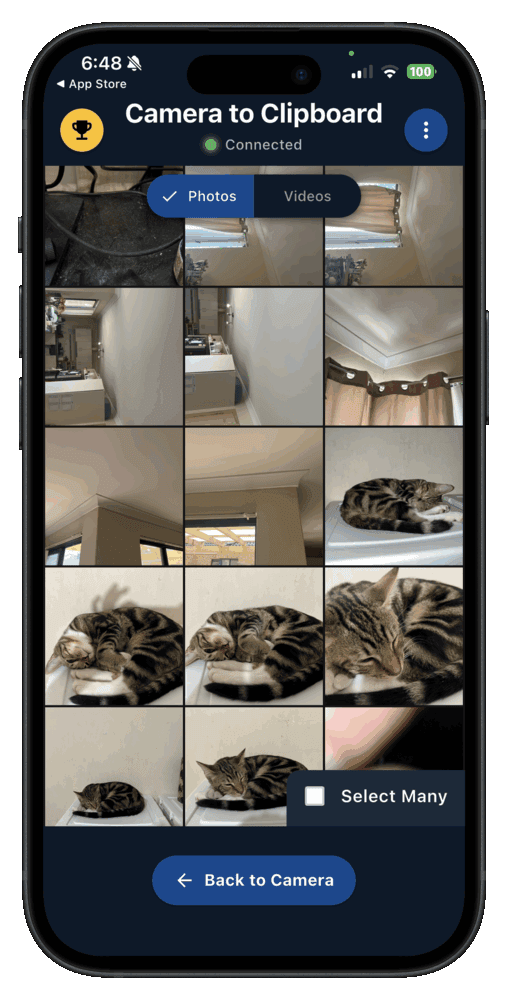
- Camera to Clipboard moves a photo from an Android phone to a Windows PC or a Mac, never to an iPhone. It will not help if the picture has to live on a phone.
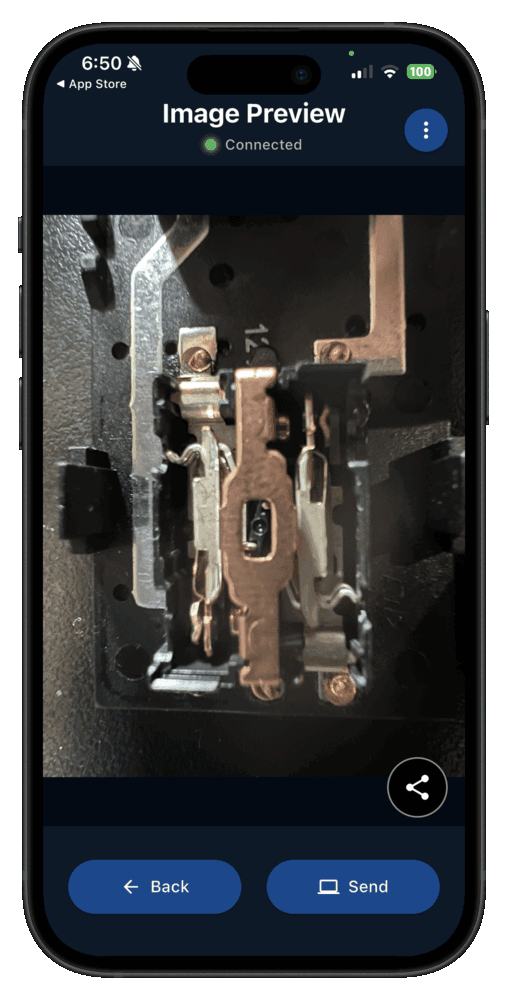
- A photo sent from Android with Camera to Clipboard lands on the computer's clipboard. Press Ctrl + V on Windows or Cmd + V on a Mac to paste it.
- Camera to Clipboard sends the Android photo straight to the computer over your own Wi-Fi. The two apps use the internet only to find each other, and the photo is never uploaded. It also works over the phone's hotspot.
Camera to Clipboard keeps full resolution and sends a batch
Camera to Clipboard also does two useful things with your photos.
- Camera to Clipboard hands the computer the Android photo at full resolution. A chat app, by contrast, recompresses every picture.
- Camera to Clipboard moves one Android photo or a whole batch at once. Videos and scanned documents travel the same way.
Setting it up takes four steps.
- Install Camera to Clipboard on the Android phone and the desktop app on the PC or Mac.
- Pair once by scanning a QR code. It takes about ten seconds.
- Take or pick a photo on the phone and send it.
- Press Ctrl + V or Cmd + V on the computer.
Free to download and try on both ends. For more options, see the best phone-to-PC transfer apps.

Apple has never opened AirDrop, so Google had to bridge it alone
The reason tells you whether a fix is coming to your phone.
- Quick Share and AirDrop grew up as separate systems that could not talk to each other. Both find a nearby device over Bluetooth, then send over direct Wi-Fi.
- A third-party app cannot add Quick Share to an iPhone, because iOS does not allow it. An iPhone app cannot join the system share sheet or wait for a file while locked.
- Sending an Android photo to an iPhone is not technically hard, so the missing Quick Share support was a business choice. The cross-platform apps below prove it with a protocol of their own.

Move to iOS runs once, and Google bridged the gap in 2025
Two exceptions exist, and only one is still useful.
- Apple's Move to iOS app copies an Android camera roll to an iPhone, but only while a new iPhone is being set up. After that it is gone, so it cannot send today's photo.
- Google connected Quick Share to AirDrop in November 2025, with no help from Apple. The next section shows how far it has spread.

Quick Share reaches AirDrop from Pixel, Galaxy and a few others
This exception started on one phone in late 2025 and has spread since.
- Google connected Quick Share to AirDrop on 20 November 2025, starting with the Pixel 10. Google's post, Android Quick Share can now work with iOS's AirDrop, has the details.
- Apple took no part in connecting Quick Share to AirDrop and has announced nothing about it. Google built the link alone, so it reached Google's phones first.
- Every Pixel from the 8a onwards, and every Galaxy from the S24 onwards, can now Quick Share to an iPhone. That covers the Pixel 9 and 10 families and the Galaxy S24, S25 and S26 families. Samsung's Z Fold 6 and 7, Z Flip 6 and 7 and Z TriFold count too.

Five other makers have one line each, and the iPhone needs a setting
Two more conditions decide whether Quick Share reaches your iPhone.
- OnePlus, Xiaomi, OPPO, vivo and HONOR each have exactly one line that can Quick Share to an iPhone. They are the OnePlus 15, the Xiaomi 17T Pro, the OPPO Find X9 series and Find N6. The list also has the vivo X300 series and the HONOR Magic V6, all added in June 2026. Motorola, Nothing and older phones still cannot.
- The iPhone must be set to Everyone for 10 Minutes before an Android phone can Quick Share to it. Contacts Only never works with Android. Our Quick Share to AirDrop troubleshooting guide covers every failure.

A messaging app sends an Android photo to an iPhone but shrinks it
Most people try a chat app first, and for a quick snap that is fine.
- WhatsApp, Messenger and Instagram shrink an Android photo on the way to an iPhone. A 4 MB camera photo often arrives as a few hundred kilobytes.
- A photo that a chat app compressed cannot be restored to full quality on the iPhone. The detail was thrown away, so editing or upscaling will not bring it back.
- WhatsApp's HD option improves a photo sent to an iPhone but does not switch compression off. The picture arrives better, and still smaller than the original.

Attach an Android photo as a document so chat apps keep its size
One trick avoids the compression, and sometimes the loss does not matter.
- Attaching an Android photo as a document stops a chat app shrinking it on the way to an iPhone. WhatsApp and Telegram both offer this, and the file crosses untouched.
- A chat app is the right tool for an Android photo the iPhone owner only needs to look at. The loss is invisible on a phone screen, but it matters for printing or editing.

A Google Drive or Dropbox link arrives at the original size
A cloud link is where most people end up once a chat app lets them down.
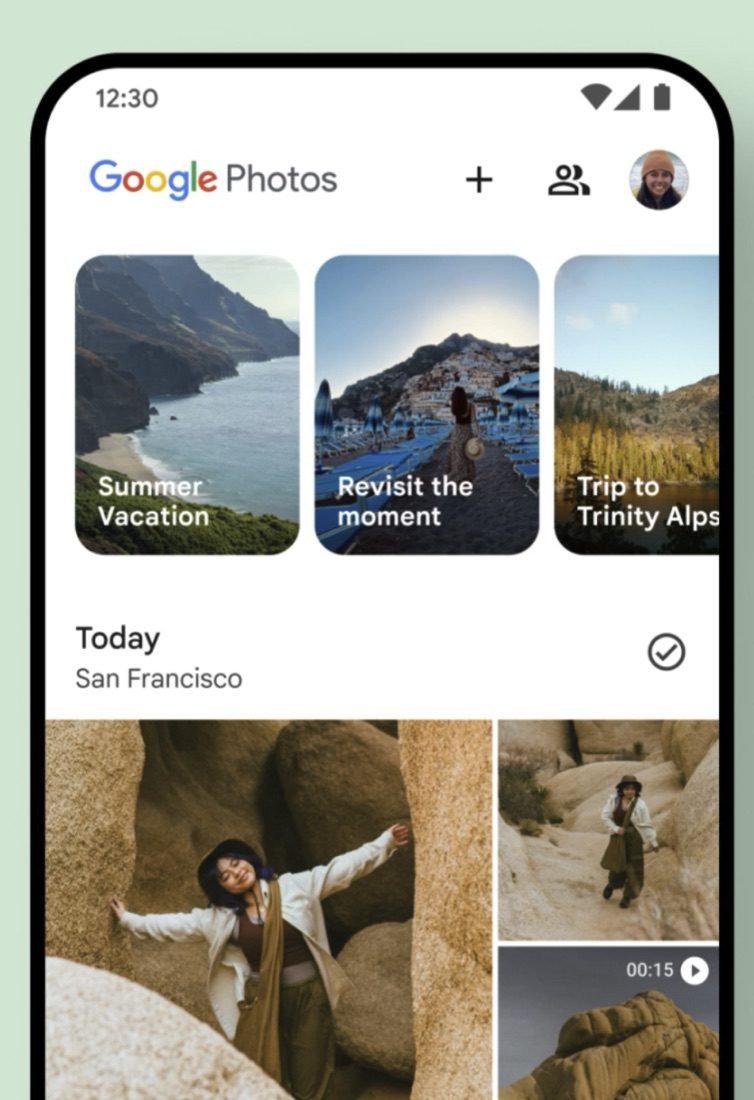
- A photo shared from Android through Google Drive or Dropbox reaches an iPhone at its original size. Both services store the file exactly as it was uploaded.
- Google Photos hands an iPhone the original only if the Android phone backs up in Original quality. Storage saver compresses every picture as it uploads.
- A cloud link is slower than a direct transfer, because the Android photo goes up to a server and back. Both phones need internet, and on a weak signal the upload is the whole wait.
A cloud link needs one account, scales to a folder and fills up
Three practical points decide how far a cloud link takes you.
- A cloud link from Android needs an account on the sending phone, but usually not on the iPhone. A link set to anyone with the link opens in the iPhone's browser with no sign-in.
- A cloud link carries a hundred Android photos to an iPhone as easily as one. Share a folder, and the iPhone owner browses one folder instead of a hundred messages.
- A big batch of Android photos can fill a free Google account, which Drive, Gmail and Google Photos share. Dropbox's free plan is smaller still. Neither limit matters for a dozen pictures.

A cross-platform app sends Android photos to an iPhone over Wi-Fi
On a phone that is not a supported flagship, these apps are the closest thing to Quick Share.
- LocalSend and Send Anywhere run on both Android and iPhone, so they can send between the two. One phone picks the photo and the other accepts it.
- LocalSend sends the picture straight from the Android phone to the iPhone over shared Wi-Fi, with no server. It is open source, needs no account and works with no internet.
- Send Anywhere reaches an iPhone far from the Android phone, because it uploads to a relay server first. You share a six-digit key or a link. Your photo sits on that server during the transfer.

A cross-platform app keeps full size but must be open on both phones
Building their own link has three results.
- A cross-platform sharing app gives the iPhone the original file, at the size the Android camera saved it. Nothing is recompressed, unlike a chat app.
- A cross-platform app must be open on both phones, on the same network, before an Android to iPhone transfer starts. iOS stops the app waiting in the background, so keep it on screen on the iPhone.
- A cross-platform app takes more setup than Quick Share, because the iPhone must install it first. On someone else's iPhone, that makes a link easier for a one-time send.

Email carries a few Android photos to an iPhone at full size
Email asks the least of the person receiving, but its limit is low.
- Emailing photos from an Android phone to an iPhone needs no extra app and no setup. On the iPhone, a long press in Mail saves the picture to the camera roll.
- Gmail refuses attachments over 25 MB, which is only a handful of modern Android photos. A 12 megapixel shot is often 3 to 5 MB, so five or six fill the limit.
- Choosing the original size when a mail app offers to shrink a photo protects its quality on the iPhone. Read the prompt rather than tapping through it.

An emailed photo lingers in two mailboxes and slows past five
Two costs show up after you send.
- An emailed photo leaves a lasting copy in the Android phone's sent folder and the iPhone's inbox. Think twice before emailing a passport page or a bank statement.
- Email gets slow and awkward past about five Android photos going to an iPhone. Each attachment must be saved one at a time, so a cloud link is less work.

A cable from Android to an iPhone means a USB stick in between
Two phones with the same port still cannot swap photos directly.
- Plugging an Android phone into an iPhone with a USB-C cable does not let either phone read the other's photos. Neither phone shows up as a drive to the other.
- Copying Android photos to a USB-C flash drive, then plugging the drive into the iPhone, does work. The iPhone's Files app reads the drive. iPhone 15 and later have USB-C, and older models need an adapter.
- A USB stick shared between an Android phone and an iPhone must be formatted so both can read it. Use exFAT, or FAT32 for small files.

A USB drive needs no network at all and costs the most effort
One reason to use a drive, and one reason not to.
- A USB drive moves Android photos to an iPhone with no network of any kind. No other method here can. That matters on a plane or with no signal.
- Buying a drive just to move a few Android photos to an iPhone costs more than any other way. Unless a stick is already in a drawer, treat it as a last resort.

A cross-platform app beats a chat app on Android to iPhone quality
Here are the five methods side by side, on the four things that decide which one to use.
| Method | Photo quality on the iPhone | Accounts needed | Photos in one go | Setup before you can send |
|---|---|---|---|---|
| LocalSend or Send Anywhere | The original file | None with LocalSend | Dozens in one send | An app on both phones |
| Google Drive or Dropbox link | The original file | One, on the sending phone | A whole folder | Upload, then send a link |
| WhatsApp or Messenger | Recompressed, often heavily | Both people on the same app | Up to 100 at a time | Three taps, nothing to install |
| Email attachment | Original unless you accept a resize | Nothing to sign up for | About five, then the size limit | None at all |
| USB-C flash drive | The original file | None, and no network either | Hundreds | A drive to buy and format |

Use a cloud link for a batch and a chat app for one quick photo
On a supported flagship, use Quick Share. Elsewhere, choose by photo count and quality.
- Quick Share is the best way to send a photo to an iPhone from a supported flagship. Google gave those phones AirDrop support from November 2025.
- A chat app is the best way to send one Android photo to an iPhone just to be looked at. It takes three taps, and the loss is invisible on a phone screen.
- A shared Google Drive or Dropbox link is the best way to send a batch of Android photos to an iPhone at full quality. The iPhone owner needs no account to open it.
- LocalSend is the best way to move Android photos to an iPhone with no account and no server. Both phones need the app and the same Wi-Fi.

Pick email, a USB drive or Camera to Clipboard for the rarer cases
Three cases remain, and each has one clear answer.
- Email is the best way to send two or three Android photos to an iPhone owned by someone you barely know. They have nothing to install or agree to.
- A USB-C flash drive is the best way to get Android photos onto an iPhone with no network at all. It is slow and needs hardware, but works with the Wi-Fi off.
- Camera to Clipboard is the best way to get an Android photo onto a PC or a Mac. Many of these photos were heading there anyway. The picture lands on the clipboard at full resolution.
Common questions about Quick Share from Android to an iPhone
Can Quick Share send photos from Android to an iPhone?
From a supported phone, yes. Google launched it on 20 November 2025 with the Pixel 10. By mid 2026 it covers Pixel 8a and later, Galaxy S24 and later, plus one line each from OnePlus, Xiaomi, OPPO, vivo and HONOR. The iPhone must be set to Everyone for 10 Minutes. No other Android phone can reach an iPhone this way.
What is the closest thing to Quick Share between Android and an iPhone?
On a supported flagship, it is Quick Share itself. On any other Android phone, it is a cross-platform app on both phones, such as LocalSend. Both phones join the same Wi-Fi, and the photo arrives at full size. The iPhone needs the app first, but no server is involved.
Does AirDrop work from an Android phone to an iPhone?
Not from an ordinary Android phone. AirDrop is Apple's own sharing, and Apple ships it only on Apple devices. No Android app offers a real AirDrop button. The exception is the supported flagships, whose Quick Share Google made work with AirDrop from November 2025, without Apple.
How do I get Android photos onto a computer instead of an iPhone?
Camera to Clipboard sends a photo from the Android phone straight to a Windows PC or a Mac over your own Wi-Fi. Nothing is uploaded to a cloud. The picture lands on the clipboard, so Ctrl + V or Cmd + V pastes it. It never sends to an iPhone.