KDE Connect comes from the Linux world, it is free and open source, and there is a Windows build. Whether it is worth installing on Windows, and what to do when it finds nothing, are both answered below.
The quick answer: install KDE Connect on Windows if you want the phone and the PC linked. You get files both ways, notifications on the desktop and shared clipboard text. Discovery is what goes wrong, and the cure is a firewall rule plus a network set to Private. Getting a photo onto the clipboard ready to paste is a different job. Free for iPhone Free for Mac Free for Android Free for Windows

KDE Connect links your phone to a Windows PC over your own Wi-Fi
KDE Connect is not a file sender with extras bolted on. It is a link between two devices, and pairing a phone with a PC gets you all of this at once:
- KDE Connect is free open source software from the KDE community, with no account and no paid tier. KDE is the group behind the Plasma desktop on Linux, and it publishes the apps itself.
- KDE Connect sends files in both directions between a phone and a Windows PC. A photo sent from the phone lands in a folder on the PC, and files go back the same way.
- KDE Connect shares copied text between a paired phone and a Windows PC. A link, an address or a one-time code crosses without you typing it.
- KDE Connect shows your phone's notifications on the Windows desktop as they arrive. A message pops up while the phone stays in your bag, and on Android you can reply from the desktop.

KDE Connect also turns the phone into a remote for the PC
Three more KDE Connect features work in the other direction.
- KDE Connect turns the phone into a trackpad and keyboard for the Windows PC. Handy when the PC is across the room on a TV, and it doubles as a presentation remote.
- KDE Connect can trigger commands on the Windows PC from the phone, once you have defined them on the PC. The phone can only fire off what you have already allowed.
- KDE Connect also handles media controls, the phone's battery level and ringing a phone you have lost. Pause the PC from across the room, or ring a phone you have mislaid.
That list is why people put up with the setup. No file sender comes close.

Camera to Clipboard puts a phone photo on the Windows clipboard
If you want a photo out of the phone and into a document, KDE Connect leaves that job half done. It sends a file. You wanted a paste.
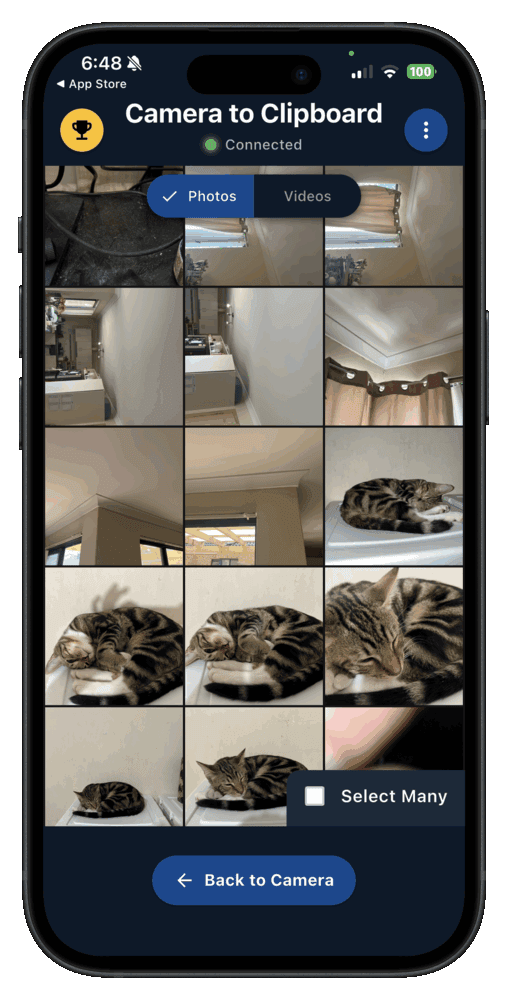
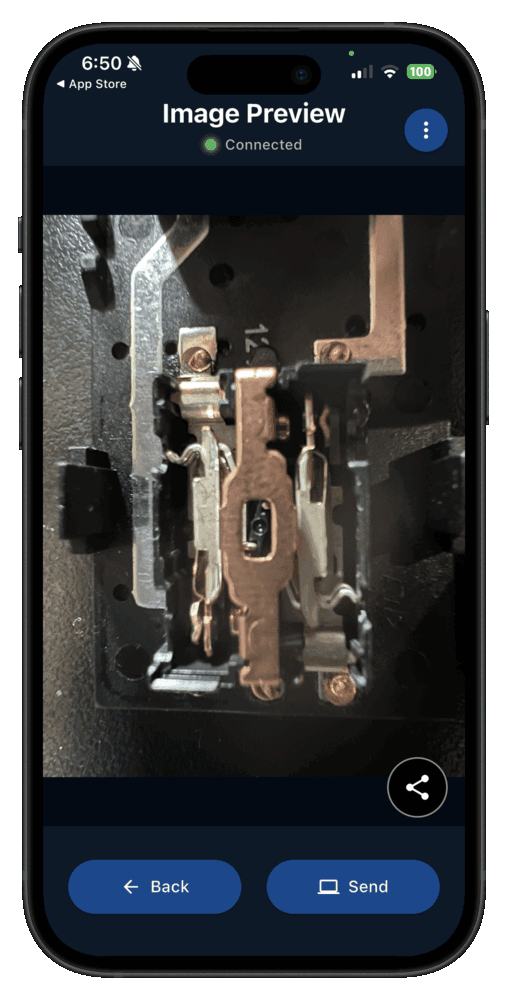
- A photo sent with Camera to Clipboard lands on the Windows clipboard, ready to paste. Press Ctrl + V in the document or the email. No folder to open, no file to attach.
- Camera to Clipboard sends the photo straight from the phone to the PC over your own Wi-Fi, with nothing uploaded. The two apps use the internet only to find each other, and a hotspot works too. The Wi-Fi transfer guide covers other local methods.
- Camera to Clipboard pairs the phone and the PC by scanning a QR code once, in about ten seconds. No firewall rule to write: the desktop app asks Windows for what it needs at install.
Camera to Clipboard sends batches but is not a full phone link
One more capability and one boundary are worth stating.
- Camera to Clipboard sends one photo or a whole batch, freshly taken or picked from the camera roll. Videos and scanned documents go across the same way.
- Camera to Clipboard does one job rather than linking everything about the phone to the PC. No notification mirroring, no remote control. If that is what you came for, KDE Connect is the better answer.
- Install Camera to Clipboard on the phone and the Windows app on the PC.
- Pair once by scanning a QR code, about ten seconds.
- Take or pick a photo on the phone and send it.
- Press Ctrl + V on the PC.
Free to download and try on both ends. The free version adds a small watermark and caps photos at 1920px. Pro removes both.

KDE Connect pairs with a phone once you install it at both ends
Setup is one install on each device and one pairing request. The whole thing takes a few minutes when discovery behaves:
- Install KDE Connect on the Windows PC, from the Microsoft Store or the project's own site.
- Install the phone app: Google Play or F-Droid on Android, the App Store on an iPhone.
- Put both devices on the same Wi-Fi network, not one on Wi-Fi and the other on mobile data.
- Open the app on the phone. The PC should appear in the device list. Tap it and request pairing.
- Accept the pairing request on the Windows PC. The two stay paired until you unpair them.
Four things about pairing explain most of what looks like a fault:
- KDE Connect only pairs devices on the same local network, so a phone on mobile data will never list your PC. No server in the middle introduces them, which is the point of the design.
- Pairing a phone and a PC in KDE Connect is a one-time step. Come home, join the Wi-Fi, and the link is back with nothing to confirm.
- KDE Connect encrypts what it sends between the paired phone and PC, and nothing passes through a company's server. The two devices swap certificates at pairing, then talk directly.
- Every KDE Connect feature can be switched off on its own in the app's plugin list. If you want file transfer but not notifications, turn that one off at either end.

Windows Firewall blocking KDE Connect is why no device appears
This failure hits almost everyone, and it looks like nothing at all. The app opens, the device list stays empty, and neither end shows an error. Three things explain it.
- KDE Connect finds devices by announcing itself across the local network, and Windows Firewall blocks that announcement by default. Both devices sit on the right Wi-Fi and neither lists the other. The announcement never arrives.
- KDE Connect needs UDP and TCP on ports 1714 to 1764 to reach the Windows PC. UDP finds the other device, TCP carries everything after. Block either half and the app looks dead.
- Allowing the KDE Connect program through Windows Firewall beats opening ports 1714 to 1764 by hand. The app rule covers whichever port it uses and goes when you uninstall it. A bare port rule stays behind.

Cover private networks, check your antivirus and restart both ends
Three details decide whether the firewall change actually takes.
- The firewall permission for KDE Connect has to cover private networks, and that is the box people miss. Windows keeps separate permissions for the two, so a public-only rule does nothing on your home Wi-Fi.
- Antivirus suites with their own firewall block KDE Connect even after Windows Firewall is allowing it. They replace or sit in front of the Windows rules, so allow the app a second time there.
- KDE Connect usually needs restarting on both the phone and the PC after a firewall change. Announcements go out when the app starts, so restart it rather than waiting.

Marking the network Private lets KDE Connect find your phone
The firewall rule is only half of it. Windows also decides, per network, whether your PC may be seen at all, and the answer defaults to no.
- Windows marks every network Public or Private, and a Public network hides your PC from KDE Connect on the phone. Public is meant for cafes and airports, so it switches off local discovery.
- Windows asks whether a new network should be discoverable, and the cautious answer is the one that breaks KDE Connect. Saying no marks the connection Public. Change it later in the network settings.
- The Private setting in Windows applies to one connection, so making your home Wi-Fi private exposes the PC nowhere else. Join a hotel network next week and it arrives as Public on its own.

Use the phone's hotspot when a managed network stays Public
One kind of network you cannot change, and the way around it.
- An office or campus network usually stays Public and blocks KDE Connect whatever you change on the PC. Managed networks keep devices apart on purpose, and you cannot undo that from the PC.
- Connecting the Windows PC to the phone's hotspot gets KDE Connect working when the Wi-Fi you are on blocks discovery. The two devices are then alone on a small network with nothing filtering them.

A VPN or a guest network hides the phone from KDE Connect
If the firewall is open and the network Private and the list still empty, the network itself is keeping them apart. Four causes cover nearly all of it:
- A VPN on the phone or the Windows PC sends traffic off your local network and stops KDE Connect pairing. Turn it off at both ends to pair. Some VPN apps can let local traffic through.
- A guest Wi-Fi network stops devices talking to each other, so KDE Connect cannot pair a phone and a PC across it. Move both onto the main network. Guest networks exist to prevent exactly this.
- Some routers separate wireless devices, which stops KDE Connect finding a phone plainly on the same Wi-Fi. Look for client isolation or AP isolation in the router. Both devices have internet and still cannot see each other.
- A Windows PC on Ethernet and a phone on Wi-Fi still work with KDE Connect, as long as both sit behind the same router. An extender or mesh unit that creates a second network breaks that.

KDE Connect really does share the clipboard, and it shares text
Clipboard sharing is one of the best reasons to install KDE Connect. Here is what crosses and what does not.
- KDE Connect genuinely shares the clipboard between a paired phone and a Windows PC. Copy a login code on the phone and paste it on the PC. No other free tool here does that.
- KDE Connect's clipboard sharing is built around text rather than images. A copied URL crosses. A photo is not handed to the Windows clipboard as something you can paste.
- Android restricts background clipboard reading, so sending copied text from an Android phone is often a manual tap. That limit is Android's own, and KDE Connect gives you a send action for it.

A KDE Connect photo arrives as a file, and only to paired devices
Two limits define what actually crosses.
- A photo sent from the phone with KDE Connect arrives on Windows as a file in a folder. Right when you are keeping the photo, a detour when it was only going into an email.
- KDE Connect shares the clipboard only between devices you have deliberately paired. Another phone on the same Wi-Fi gets nothing, because pairing is what authorises the link.
The distinction is not clipboard against no clipboard. It is text against images, and which of the two you need.

KDE Connect on Android does more than the iPhone version does
Which phone you have changes what you get, and the gap is wider than most download pages admit.
- The KDE Connect Android app carries the full feature set, including notification mirroring, clipboard sharing, remote input and file transfer. Android allows all of it, which is why nearly every screenshot you find is the Android one.
- The KDE Connect iPhone app is free and real, and does less than the Android app. File sharing, remote input and the presentation remote are there. Notification mirroring is not, because Apple blocks it.
- An iPhone limits KDE Connect in the background, so the link to the PC drops when you switch away. You often have to open the app on the iPhone before the Windows PC will list it.
- Nothing about KDE Connect needs Linux on the computer, despite where the project comes from. The Windows build is supported by the project, not a community side effort, and there is a macOS build too.

The Windows build of KDE Connect is rougher than the Linux one
A download page will not tell you this, and it is no criticism of a free project. Three gaps stand out.
- KDE Connect started on Linux and the Windows build came later, so Windows gets the polish second. Far more people run it on Linux and report what breaks there.
- Discovery is the part of KDE Connect that fails on Windows and rarely on Linux. Many Linux desktops ship with no firewall on, so the app just works. On Windows you write it a rule first.
- Features in KDE Connect that lean on the Plasma desktop are thinner or missing on Windows. Browsing phone storage in the file manager and the desktop widgets are Plasma pieces, with no full Windows equal.

KDE Connect asks for ten minutes and gives back a linked phone
What the extra setup buys you is worth naming.
- Setting KDE Connect up on Windows asks more of you than a commercial app would. Nobody is paid to smooth over the first run. In exchange there is no account, no advertising and no cloud.
- KDE Connect is worth installing on Windows if you want the phone and the PC linked rather than files moved. Desktop notifications and the phone as a remote are things a file sender does not attempt.

KDE Connect does more than its alternatives and asks more of you
People want a KDE Connect alternative for one of two reasons: less setting up, or the one feature it stops short of. Four tools cover both.
- LocalSend is the closest free open source alternative to KDE Connect for moving files to a PC. It runs on Windows, macOS, Linux, Android and iPhone with no account and no pairing. No notifications, clipboard or remote input.
- PairDrop sends a file between a phone and a Windows PC through the browser, with nothing installed at either end. Open the same page on both devices and drag the file across. The Snapdrop and PairDrop guide covers it properly.
- Microsoft Phone Link is Windows' own take on the KDE Connect idea, mirroring an Android camera roll onto the PC. It needs a Microsoft account and its photo panel has never worked with an iPhone. The Android to PC guide covers it.
- Camera to Clipboard covers the one thing KDE Connect stops short of, an image arriving on the Windows clipboard. It is not a phone link, so it competes on one task only.
| Tool | Setup effort | What reaches the PC | Cost | How well it works on Windows |
|---|---|---|---|---|
| Camera to Clipboard | One app each end, paired by QR code | A photo on the clipboard, ready to paste | Free to download and try | Built for Windows |
| KDE Connect | Install, pair, then a firewall rule | Files, copied text and notifications | Free and open source | Works, but discovery is fiddly |
| LocalSend | One app each end, no pairing | Files into a folder | Free and open source | Steady on Windows |
| PairDrop in a browser | Nothing to install | Files into Downloads | Free | Any browser works |
| Microsoft Phone Link | Sign-in and phone permissions | Android photos, no iPhone photos | Free, already on Windows | Made by Microsoft |

KDE Connect suits the whole phone link, not a photo you need now
All five tools above work. Which one fits depends on what you are moving from the phone to the PC.
- Install KDE Connect on Windows if you want phone notifications on the desktop and files moving both ways. Nothing else free covers that span, and it is worth the firewall rule.
- Install KDE Connect if you specifically want free open source software with no company behind the link. No account, no advertising, no server holding your files, and the code is public.
- Use LocalSend rather than KDE Connect if you only want to send a file to a Windows PC. Same spirit, no pairing and no plugin list. The phone to PC transfer apps roundup compares the wider field.

Pick Camera to Clipboard for photos, and managed Wi-Fi beats them all
One pick for photos, and the one network that defeats every tool.
- Use Camera to Clipboard when the phone photo is going straight into a document or an email on the PC. It ends in a paste, not a file.
- Expect no phone-to-PC transfer tool, KDE Connect included, to work on a managed office or campus network. Those networks keep devices apart by design, and a phone hotspot is the usual way around it.
Common questions about KDE Connect on Windows
Does KDE Connect work on Windows?
Yes. KDE Connect has an official Windows build from the KDE project, and it pairs with the Android or iPhone app over your local network. It is a Linux-first project, so the Windows build is less polished. Windows Firewall is almost always the reason it finds nothing.
Why does KDE Connect not find my phone on Windows?
Almost always Windows Firewall, the network profile, or both. KDE Connect needs UDP and TCP on ports 1714 to 1764, and Windows hides your PC on any connection marked Public. Allow it through the firewall for private networks, set the Wi-Fi to Private, and turn off any VPN.
Does KDE Connect share the clipboard between a phone and a PC?
Yes, for text. Copy text on one paired device and paste it on the other. It does not put an image on the clipboard, so a photo from the phone arrives as a file in a folder.
Is KDE Connect free?
Yes. KDE Connect is free and open source software from the KDE community, with no paid tier, no account and no advertising. The Windows, Android and iPhone apps are all free, and the code is public.