Quick Share is built into every Android phone, but a Windows PC has nothing until you go and fetch it. Google publishes a free app for that, it is still labelled beta, and it has a few hard edges worth knowing before you rely on it. Here is how to set it up and where it stops.
The quick answer: Quick Share for Windows is a free app from Google that lets an Android phone send files straight to a PC over your own network. You install it on the PC, sign in or stay signed out, and the PC then shows up in the phone's Quick Share list. It needs 64-bit Windows 10 or later, Bluetooth and Wi-Fi. It saves what it receives as a file, so if what you actually want is to paste a photo, one small app does that instead. Free for iPhone Free for Mac Free for Android Free for Windows

Quick Share for Windows is a free app from Google, not part of Windows
The name misleads people, so start with what the thing actually is.
- Quick Share for Windows is a separate free app published by Google, and Windows does not come with it. A PC with nothing installed never appears in your phone's Quick Share list, no matter what either device is set to.
- Quick Share for Windows is the desktop half of the feature Android already has built in. The phone side needs no download, because Quick Share ships with Android.
- Quick Share for Windows was called Nearby Share for Windows until Google merged the two names in 2024. Older guides and older download links still use the previous name. It is the same app.
- Quick Share for Windows sends files in both directions, from the phone to the PC and from the PC back to the phone. Most people only ever use one direction, but both work.
- Quick Share for Windows moves the file across your own network, so it is not uploaded to Google. Nothing is stored on a server in between.

Install Quick Share for Windows in four steps
Setting it up is a one-time job on the PC, and the phone needs nothing at all.
- Download Quick Share for Windows from Google's own Android site. Avoid any other download page.
- Run the installer and open the app.
- Sign in with the same Google account as your phone, or skip signing in.
- Give the PC a name and choose who is allowed to see it.
Signing in is the part worth doing. Signed in, your own phone finds the PC with no further setup. Signed out, the only visibility level available is the one that also exposes the PC to strangers nearby.
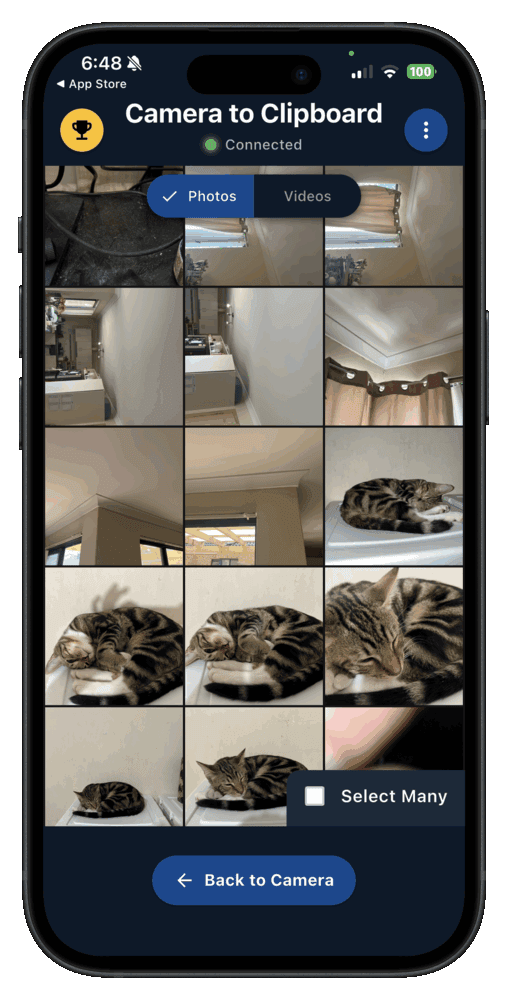
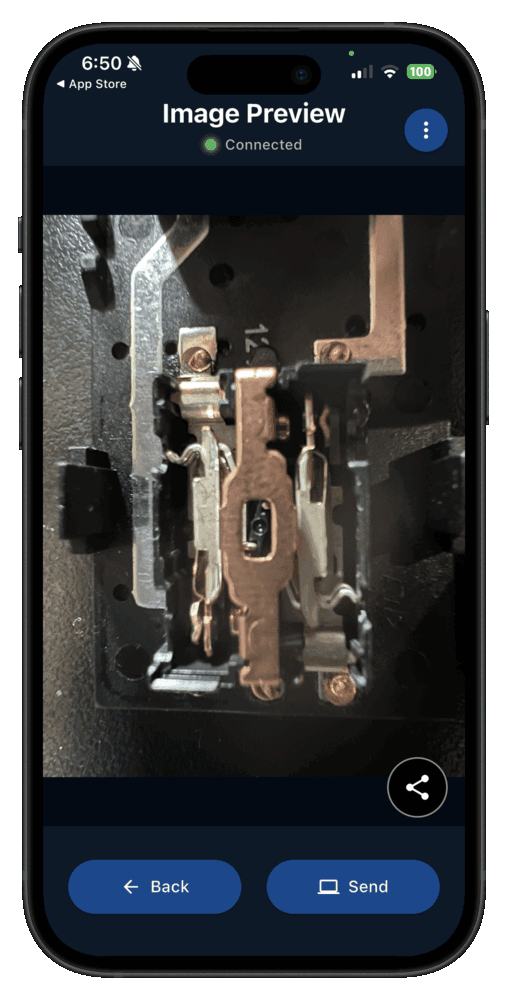
Camera to Clipboard puts an Android photo on the Windows clipboard
Quick Share hands you a file. If the photo is going straight into an email, a document or a chat, a file is one step too many, and a different tool skips it.
- A photo sent with Camera to Clipboard lands on the Windows clipboard, ready for Ctrl + V. There is no folder to open afterwards and no file to attach.
- Camera to Clipboard runs on any Android phone and on iPhone, so it covers the phones Quick Share cannot. Quick Share for Windows is Android only, with no iPhone support at all.
- Camera to Clipboard runs on Windows and on Mac, so it also covers the computer Quick Share cannot. Google publishes no Mac version of Quick Share.
- Camera to Clipboard sends the photo from the phone to the PC across your own network. Nothing is uploaded to a cloud service. The two apps use the internet only to find each other, so a phone hotspot works as well.
- Camera to Clipboard sends one photo or a whole batch straight from the phone's gallery. Scanned documents and video clips cross the same way.

Pair Camera to Clipboard with your Windows PC in four steps
Pairing happens once, and it takes about ten seconds.
- Install Camera to Clipboard on the phone and the Windows app on the PC.
- Pair them once by scanning a QR code.
- Take or pick a photo on the phone and send it.
- Press Ctrl + V on the PC.
A video clip travels the same way. It is saved as a file on the PC, never re-encoded, and its file path goes on the clipboard.
Free to download and try on both ends. The free version adds a small watermark and caps photos at 1920px. Pro removes both.

Quick Share for Windows needs 64-bit Windows 10 and both radios on
Three requirements catch people out, and the app does not always explain which one you failed.
- Quick Share for Windows requires 64-bit Windows 10 or Windows 11. An older Windows version cannot run it at all.
- Quick Share for Windows does not run on a Windows laptop with an ARM processor. That rules out several thin-and-light machines, and it is the requirement people miss most often.
- Quick Share for Windows needs both Bluetooth and Wi-Fi switched on at the PC and at the phone. Bluetooth is how the two devices find each other and Wi-Fi is how the file actually crosses, so switching either off breaks it.
- Quick Share for Windows needs the PC and the phone reasonably close together while they pair. Bluetooth range decides that, not your Wi-Fi coverage.

Send a file from an Android phone to Windows in four steps
Once the PC is set up, sending looks exactly like sending to another phone.
- Open the photo or file on the Android phone and tap Share.
- Tap Quick Share.
- Pick the PC by the name you gave it.
- Accept the transfer on the PC.
The file lands in whatever folder you picked during setup, usually Downloads. The app has to be running for the PC to be visible, which is the single most common reason a PC that worked yesterday is missing today.

Quick Share for Windows saves a file, so a photo needs another step
This is the difference people notice within a day of using it, and it is worth being clear about.
- Quick Share for Windows writes whatever it receives into a folder on the PC. A received photo is a file sitting in Downloads, not something waiting on the clipboard.
- Pasting a photo received through Quick Share for Windows means opening the folder and dragging or attaching the file. That is two or three extra actions every single time.
- A file is exactly what you want when the photo is being kept, archived or edited later. Quick Share is the right tool for that job.
- A file is the wrong shape when the photo is going straight into an email or a document you already have open. That is the case Camera to Clipboard was built for.

The visibility setting decides whether your phone can see the PC
The PC has the same four visibility levels the phone has, and picking the wrong one is why a PC goes missing.
- Setting the PC to Your devices shows it only to phones signed into the same Google account. This is the right choice for a PC you own, and it needs you to be signed in.
- Setting the PC to Your contacts shows it to people saved in your contacts who are also signed in. It suits a shared machine in a household or an office.
- Setting the PC to Everyone shows it to any Android phone in Bluetooth range, including strangers. It is the only level available when you are not signed in, which is why signing in matters.
- Setting the PC to receive from nobody hides it completely, and the phone will simply not list it. People often land here by accident and assume the app is broken.
- Closing the Quick Share window on the PC also makes the PC disappear from the phone. The app has to be running, not merely installed.

Samsung ships a different Quick Share app for Windows
Two apps share this name on Windows, and mixing them up wastes an afternoon.
- Google's Quick Share for Windows works with any Android phone, and it is the one this guide describes. You download it from Google's Android site.
- Samsung ships its own Quick Share app for Windows, which comes preinstalled on Galaxy Book laptops. It is a separate program written by Samsung that happens to carry the same name.
- Having both Quick Share apps installed on one PC leads to the phone listing the machine twice, or not at all. Pick one and remove the other if transfers start behaving oddly.
- A Galaxy phone can use either Quick Share app, so the choice on a Galaxy Book is genuinely yours. On any non-Samsung PC, Google's is the only option.

Quick Share for Windows does not run on a Mac or an ARM laptop
Two machines are simply out of scope, and no setting on either end changes that.
- Google has never published a Mac version of Quick Share, so an Android phone cannot Quick Share to a Mac at all. Camera to Clipboard covers that pair, or the Android to Mac guide lists the other options.
- Quick Share for Windows does not support Windows laptops built on ARM processors. The installer will not help you on one of those machines.
- Quick Share for Windows has no iPhone support of any kind. It is an Android feature that Google extended to Windows, and Apple is not part of it.

Five ways to get an Android file onto Windows, compared
Quick Share is one of several, and which one suits you depends on what happens to the file next.
| Method | What you install | Where the photo ends up | Works with an iPhone | Best for |
|---|---|---|---|---|
| Quick Share for Windows | A free app on the PC | A file in a folder | No, Android only | Files you are keeping or editing later |
| Camera to Clipboard | An app on both ends | On the clipboard, ready to paste | Yes, and on Mac too | A photo going straight into an email or document |
| Microsoft Phone Link | Nothing, it ships with Windows | A window you copy from | Partly, with less support | Recent photos plus texts and calls |
| LocalSend or PairDrop | An app or a browser tab | A file in a folder | Yes, both platforms | Occasional transfers with no account |
| Cloud drive or email | Nothing new | A download after an upload | Yes, any phone | Sending to someone else as well as yourself |
Two of those rows are the real choice for most people.
- Quick Share for Windows wins when the file is not a photo, or when the photo is being filed away rather than used now. It handles any file type and sets no size limit.
- Camera to Clipboard wins when the photo is about to be pasted somewhere. It removes the folder step entirely, and it works from an iPhone and onto a Mac, which Quick Share cannot do.

Quick Share for Windows is still a beta, so it drops out sometimes
Google has carried the beta label on this app for a long time, and it behaves like one.
- Quick Share for Windows has to be running for the PC to appear, and closing the window is enough to hide it. Leaving it minimised in the system tray is the usual fix.
- Quick Share for Windows loses the PC from the phone's list after a sleep or a Bluetooth glitch. Restarting the app on the PC brings it back faster than any other step.
- Quick Share for Windows can fail partway through a large transfer and leave a half-written file. Delete the partial file before trying again, or the second attempt lands beside it.
- A corporate or guest Wi-Fi network that isolates devices from each other blocks Quick Share for Windows entirely. The phone and the PC must be able to reach each other on the same network.

Use Quick Share for a file and Camera to Clipboard for a photo
These two are not really rivals, and most people end up with both.
- Install Quick Share for Windows if you regularly move documents, archives or long videos from an Android phone to a PC. It is free, it is from Google, and no file type is off limits.
- Install Camera to Clipboard if what you mostly move is a photo you are about to paste. It saves the folder step every time, and it is the only one of the two that also handles an iPhone or a Mac.
- Keep Microsoft Phone Link in mind if you also want texts and calls on the PC. It already ships with Windows, so it costs nothing to try. The Phone Link guide covers it when photos stop appearing.
Common questions about Quick Share for Windows
Is Quick Share for Windows free?
Yes. Google publishes it at no cost and there is no paid tier. It is still labelled a beta, which is why it sometimes drops off the phone's list and needs restarting.
What does Quick Share for Windows need to run?
A 64-bit version of Windows 10 or Windows 11, with both Bluetooth and Wi-Fi switched on. It does not run on Windows laptops built on ARM processors, and there is no Mac version at all.
Why can my phone not see my PC in Quick Share?
Most often because the Quick Share app is not open on the PC, since it has to be running rather than merely installed. After that, check that the PC's visibility is not set to nobody, that both devices have Bluetooth and Wi-Fi on, and that they are on the same network and close together.
Where do files sent by Quick Share go on Windows?
Into the folder you chose when you set the app up, which is the Downloads folder unless you changed it. A photo arrives as a file there, so pasting it into an email means opening the folder first. Camera to Clipboard puts the photo straight on the clipboard instead.
Can Quick Share for Windows send from an iPhone?
No. Quick Share is an Android feature and the Windows app only pairs with Android phones. To get an iPhone photo onto a Windows PC, Camera to Clipboard puts it on the clipboard, and the AirDrop for Windows guide covers the other routes.