Xender is easy between two phones. The computer side is where people get stuck, often following a guide to a QR code page that has since shut down. Two methods do work, and here they are.
The quick answer: Put the phone and the PC on the same Wi-Fi. Open Connect PC in Xender and type the address it shows into a browser. Nothing is installed on the computer. With no shared network, let the computer join the phone's hotspot. Both ways end in a file, not a paste. Free for iPhone Free for Mac Free for Android Free for Windows

Xender connects to a PC through a browser, not a desktop app
Most people arrive expecting an installer, and there is not one:
- Xender is a phone app, and its computer support is a web page, not a program you install on the PC. Everything on the computer happens in a browser tab.
- Connecting Xender to a PC puts nothing on the computer, because the phone runs the web server the browser opens. The address you type is the phone's own, so the connection ends when the phone leaves the network.
- Xender's own site says a phone needs no USB cable and no extra PC software to connect to a computer. A download page offering a Xender desktop installer is not from Xender.
- Xender is free because it is ad supported, and its Google Play listing shows more than 500 million downloads. The listing carries the "contains ads" label, so expect ads while you move files.

Camera to Clipboard sends a phone photo straight to the PC clipboard
If you want a photo in an email, a document or a chat, there is a shorter way. It ends in a paste, not a file.
- A photo sent from a phone with Camera to Clipboard arrives on the computer's clipboard, ready for Ctrl + V. There is no downloads folder to open and nothing to attach.
- Camera to Clipboard sends the photo straight from the phone to the computer over your local Wi-Fi, with no cloud upload. The two apps use the internet only to find each other. A phone hotspot works too, because its mobile data connects both apps.
- Camera to Clipboard is paired once by scanning a QR code, and every transfer after that is one tap on the phone. There is no address to read off and retype each time.
- Camera to Clipboard moves one photo or a whole batch from a phone to a computer in a single send. Take a fresh shot or pick several from the camera roll. Videos and scanned documents go across the same way.
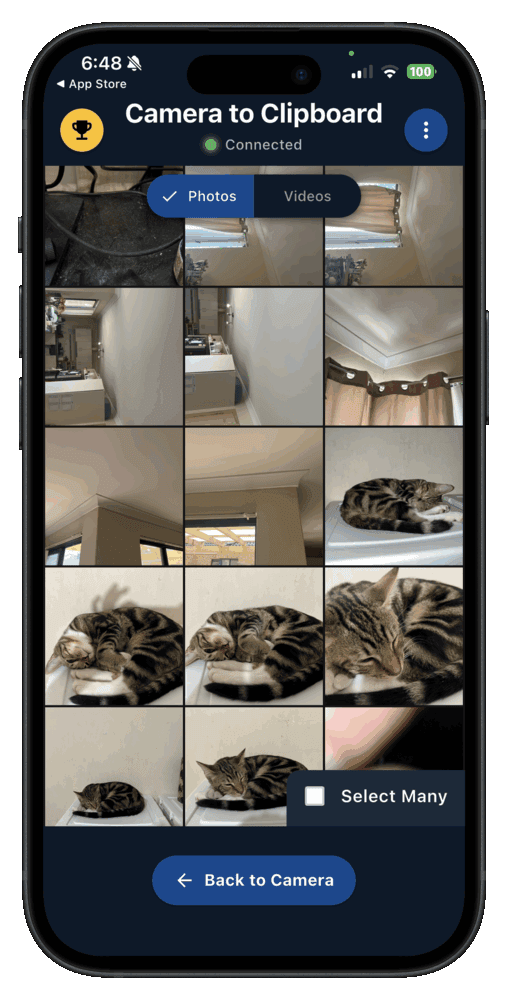
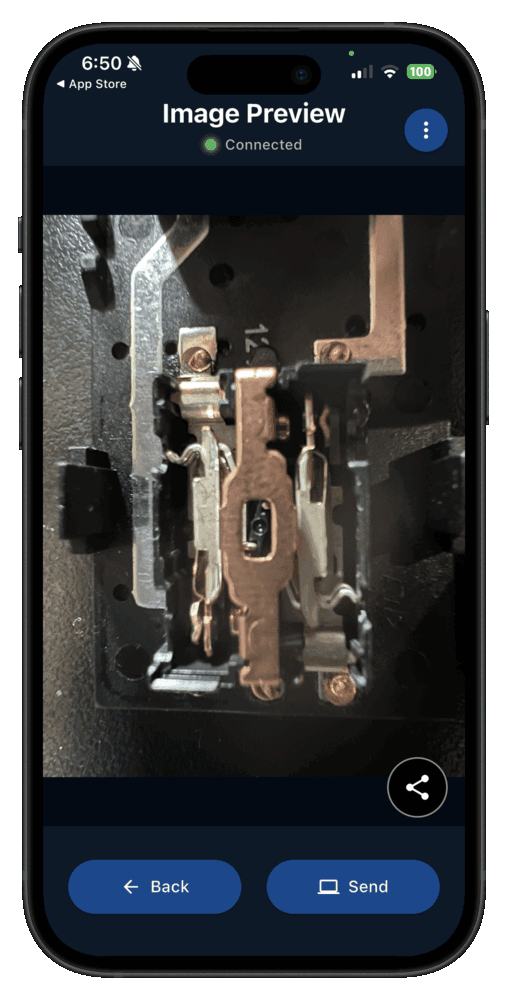
Set up Camera to Clipboard once by scanning a QR code
Camera to Clipboard runs on iPhone and Android, with a desktop app for Windows and macOS. Unlike a browser page, it needs installing on both ends, but only once:
- Install Camera to Clipboard on the phone and the desktop app on the computer.
- Pair them once by scanning a QR code. It takes about ten seconds.
- Take or pick a photo on the phone and send it.
- Press Ctrl + V on the computer, or Cmd + V on a Mac.
Free to download and try on both ends. The free version adds a small watermark and caps photos at 1920px. Pro removes both.

Connect Xender to PC by typing the phone's address into a browser
Use the browser method when the phone and the computer share a Wi-Fi network. It takes about a minute the first time:
- Put the phone and the computer on the same Wi-Fi network. Everything else depends on this step.
- Open Xender on the phone and find Connect PC. It sits behind the menu or plus button in a top corner, and it moves between versions.
- Read the web address the phone shows. It is a local address like 192.168.x.x with a port number, not a public website.
- Type that address into any browser on the computer. Chrome, Edge, Firefox and Safari all work.
- Accept the connection request on the phone. Nothing loads on the computer until you do.
- Browse the phone's photos, videos, music and documents in the browser tab, and download the ones you want.

Keep the phone awake and read a fresh Xender address each session
Four things to know before you rely on the browser method:
- The address Xender shows on the phone changes between sessions, so a bookmark in the PC browser will not work tomorrow. Your router hands out addresses on a lease, and the port can change too.
- Typing the Xender address by hand is more reliable than any QR code shortcut for connecting to a PC. It is about a dozen characters and works the same in every browser, with no camera step to go wrong.
- Xender's connection to a PC ends as soon as the phone screen locks or the app closes. The phone is the server. Keep the app open and the screen on while files move.
- Xender's Connect PC page also sends files from the computer up to the phone. Pick them in the browser tab and they arrive on the phone. Most guides forget this direction.

Xender's hotspot mode reaches a PC when there is no shared Wi-Fi
Sometimes there is no network both devices can join, or the network blocks traffic between them. Then the computer can join the phone instead. Xender's own site calls this the data free mode:
- Turn on the personal hotspot in the phone's settings, and note its name and password.
- Connect the computer to that hotspot like any other Wi-Fi network.
- Open Xender on the phone, choose Connect PC, and read the address it shows.
- Type that address into the browser on the computer, then accept the request on the phone.
Xender documents the hotspot mode in its Android instructions only. Its iPhone instructions cover the shared Wi-Fi method alone. On an iPhone, treat the hotspot as an undocumented fallback.

Xender's hotspot mode costs no data but takes the PC off its Wi-Fi
The hotspot mode has one saving and one cost to watch:
- Xender's hotspot mode spends no mobile data, because the files never leave the two devices. The hotspot works as a private network here, not as an internet connection.
- A computer joined to a phone's hotspot for Xender is off its usual Wi-Fi until it switches back. Windows and macOS may then send your browsing through the phone's mobile data. Turn mobile data off first to avoid a surprise bill.

Xender closed web.xender.com, so old QR code guides no longer work
If a guide sent you to a page with no QR code on it, you did nothing wrong. That page is gone:
- Opening web.xender.com on a computer today shows a notice reading "Website mode is closed", with no QR code. The page still loads, so it looks like a broken step, not a retired feature.
- The closed web.xender.com page tells you to set up a hotspot on the phone and connect the PC to it. It calls that the direct mode. It is the hotspot method covered above.
- Any article telling you to scan a QR code at web.xender.com was written before the page shut down. Treat the QR step as a sign that the whole guide is out of date.

Type the address Xender shows on the phone instead of web.xender.com
Xender's help pages and its closed web page disagree, which causes most of the confusion:
- Xender's help pages still describe a web mode next to the hotspot mode, so the help is behind Xender's own site. It is not your setup at fault.
- Connecting Xender to a PC does not depend on web.xender.com, because the phone itself serves the address it shows. Xender's Android and iPhone instructions both say to open that address.

Put the phone and the PC on the same network so Xender connects
If the browser sits on "connecting" forever, this is nearly always why. The check takes ten seconds:
- A phone still on mobile data cannot be reached by a PC browser, even with Xender's Connect PC screen open. The address belongs to a network the computer is not on. Join the Wi-Fi and read the address again.
- A desktop PC on ethernet and a phone on Wi-Fi are often on two different networks, which stops Xender connecting. They can share a router and still be kept apart. This is common on work machines, or with a second router or range extender.
- A phone on 5 GHz and a computer on 2.4 GHz can fail to reach each other in Xender, even on one router. Most routers bridge the two bands, but some do not. The two often have slightly different names, so put both devices on one.

Turn off a VPN, then check the firewall if the Xender page stalls
If both devices are on one network and the Xender page still will not load, check these two:
- A VPN running on either the phone or the computer breaks Xender's connection to the PC. It sends traffic away from your local network, so the local address stops working. Turn the VPN off for the transfer.
- Some laptop firewalls block outgoing connections to local addresses, which stops the Xender page loading. This is rarer than the network causes, so check it last. Try a second browser before you change firewall rules.

Guest and office Wi-Fi block Xender from reaching your PC on purpose
Both devices say they are on the same Wi-Fi, and the browser still cannot reach the phone. Retrying will not fix this one:
- Hotel, cafe and airport guest Wi-Fi usually stops devices on it from talking to each other, which blocks Xender from reaching a PC. Every device can reach the internet and nothing else. It is a security feature, not a fault.
- University and corporate networks keep their devices apart by design, so Xender's Connect PC page will not load on a work laptop. Large networks assume the machines on them do not trust each other.
- Any tool that pairs two devices over the local network fails on a guest network, not just Xender. Browser transfer pages, printer discovery and casting to a TV all break the same way, a sign the network is the problem.

Use the phone's hotspot to get Xender past a guest Wi-Fi block
Once you know the network is blocking you, stop retrying and go around it:
- No setting inside Xender can undo a network that refuses to pass traffic between two devices. The block happens at the access point, before the app is involved. Reinstalling Xender changes nothing.
- The phone's own hotspot is the reliable way around a guest network that blocks Xender. You build a two device network with nothing to filter it. The steps are in the hotspot mode section above.
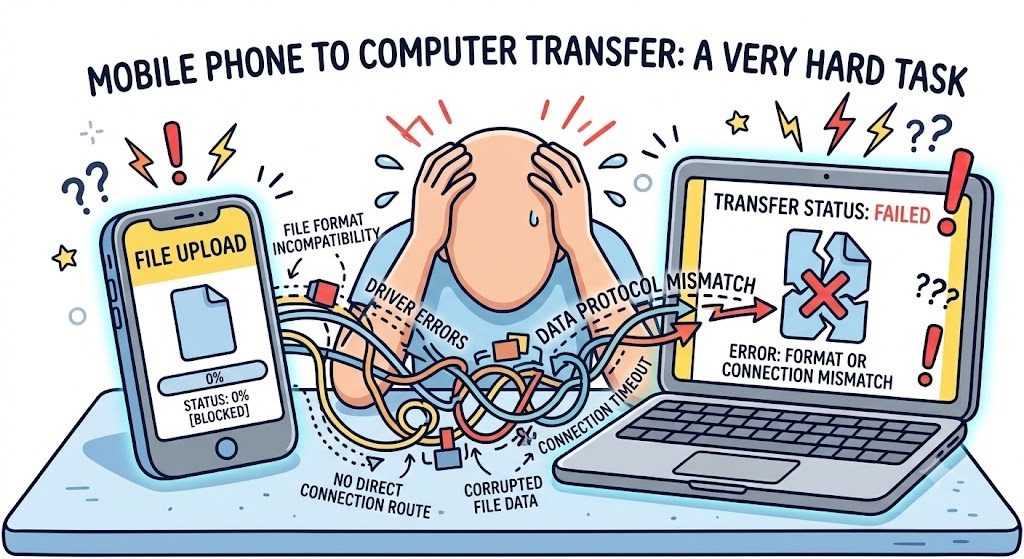
Every Xender transfer ends as a file you still have to find and open
Xender does what it says. The slow part is what happens after the file arrives:
- A photo pulled off a phone through Xender's browser page lands in your downloads folder, not in the document you were writing. Getting it into an email means a save, a window switch and an insert dialog.
- Downloading several photos through the Xender browser page gives you a pile of separate files with the phone's own names. Names like IMG_20260809_142233 tell you nothing. A batch you meant to use in order becomes a sorting job.
- Xender was built for phone to phone transfer, and its PC support is a browser workaround, not a desktop product. Two phones swap files over a Wi-Fi link Xender makes itself. The computer end has no window, no settings and no memory of yesterday's connection.

Xender gets tiresome when you move photos to a PC every day
Two costs are small the first time and grow with daily use:
- Xender shows ads while you use it, which is the cost of a free file transfer app. An ad in a daily task wears thin faster than one in a tool you open twice a year.
- Setting up the Xender connection from scratch is what stings when you move photos to a PC every day. Reading an address off a phone and typing it into a browser is fine once, and a chore by the fifth time this week.

Xender needs nothing installed on the PC but still ends in a file
Here are six ways to get a photo from a phone onto a computer. Xender's strength is needing nothing on the computer. Its cost is that you end up with a file.
| Method | Time to move one photo | Works with no internet | What must be installed on the computer | What you end up with |
|---|---|---|---|---|
| Camera to Clipboard | Seconds | Needs internet to connect, the photo stays on your Wi-Fi | A desktop app, installed once | A paste, ready for Ctrl + V |
| Xender on shared Wi-Fi | Under a minute, plus typing the address | Yes, once both are on one network | Nothing, any browser will do | A file in the downloads folder |
| Xender hotspot mode | A minute or two, plus hotspot setup | Yes, the computer joins the phone | Nothing, any browser will do | A file in the downloads folder |
| USB cable | A minute, once you find a cable | Yes | Nothing on Windows, an app on a Mac | A file in a folder you chose |
| Google Photos or OneDrive | Minutes, upload then download | No, both ends must be online | A browser sign in or a sync app | A file in the downloads folder |
| Emailing it to yourself | A minute or two each way | No | Nothing, a browser or mail app | A shrunken copy in an attachment |

Use Xender for a backup and Camera to Clipboard for one photo
Both tools earn their place, in different situations. Find yours below:
- Xender's Connect PC page is the best way to pull a folder of files off a phone onto a computer you cannot install anything on. A library computer, a friend's laptop or a locked down work machine all run a browser.
- Camera to Clipboard is the best way to get a phone photo into a document or an email you already have open. The photo lands on the clipboard, so the job ends at Ctrl + V.
- Camera to Clipboard is the better choice when you move photos from a phone to the same computer every day. You pair once and never again. A browser transfer starts from a fresh address every session.

Use Xender's hotspot on guest Wi-Fi and a USB cable for a camera roll
Two situations call for something other than a normal Wi-Fi transfer:
- Xender's hotspot mode is the best way to move files to a computer with no usable Wi-Fi. On a hotel network or in a car, the phone becomes the network. Our guide to transferring photos over Wi-Fi covers the other methods.
- A USB cable is still the fastest way to copy thousands of photos off a phone for archiving. Wireless transfer of any kind is the wrong tool for a whole camera roll. Our roundup of phone to PC transfer apps covers the alternatives.
Common questions about connecting Xender to a PC
How do I connect Xender to my PC?
Put the phone and the computer on the same Wi-Fi network. Open Xender, choose Connect PC, and type the address it shows into any browser on the computer. Accept the request on the phone. Nothing is installed on the PC, because the phone runs the web server.
Do I need to download a Xender program for my PC?
No. Xender's own site says Connect PC needs no USB cable and no other PC software. Xender offers no PC program of its own. Treat a Xender desktop installer from anywhere else like any unsigned download.
Why will Xender not connect to my PC?
Almost always because the phone and the computer are not on the same network. Check that neither is on mobile data, a different band or a different router. The other common cause is a guest, hotel or office network that keeps devices apart. The hotspot mode avoids both, because the PC joins the phone directly.
Is web.xender.com still working?
No. The page now says website mode is closed. It asks you to set up a hotspot on the phone and connect the PC to it instead. Any guide that says to scan a QR code there was written before the shutdown.